STUDENT PROFILE: Samantha Ramirez
 Samantha Ramirez is a first-year master’s student at the Institute for the Oceans and Fisheries (IOF). She is one of a small group of researchers at the IOF doing freshwater research. Her thesis project will examine how land use, flow regulation, and global warming affect water quality and the amount of oxygen in streams surrounding the Fraser River.
What drew you to the IOF?
I always said that I’d never do my master’s unless I completely loved the project that I’d be working on because I knew I’d be working on it for two years. I talked to previous grad students who said, “make sure you love the work you’re doing because it’s going to make it that much easier.” I had this idea that I really wanted to research the impacts of agriculture on aquatic ecosystems, specifically stream ecosystems. The project that my supervisor, Jordan Rosenfeld, had in mind was exactly the thing I was looking for.
Which part of your project excites you the most?
Definitely the field work! I’m in this program because I love being outdoors and I love being outside and studying the natural environment, so seeing the project come to life is what I’m most excited for.
How will your project help with fish conservation efforts?
I’m going to be creating a model that will predict the hypoxic (lack of oxygen) conditions of streams in the near and far future (e.g. 20, 30, 80 years from now). I want to provide that information to governmental organizations, so they know where to focus their conservation efforts in terms of which streams are going to be the most impacted by our changing environment. Freshwater conditions will impact Coho salmon, a very economically and culturally important species in B.C., and also Salish sucker, which is a threatened Species at Risk.
You’re from Ontario. How are you finding Vancouver?
I love Vancouver. The first month I was here I was going to so many different areas of B.C., like Whistler and out towards Revelstoke. I’ve been taking advantage of being so close to the mountains and the ocean, going paddle boarding, scuba diving, rock climbing, and hopefully skiing soon. I think my parents were hoping that I wouldn’t love the West Coast and that I’d move back to Ontario right after my master’s, but so far that’s not looking good for them.
Tags: British Columbia, fish stocks, freshwater, IOF students, species distribution
STUDENT PROFILE: Meaghan Efford

Meaghan Efford is a second-year PhD student with the Institute for the Oceans and Fisheries (IOF). Many students study zoology or ecology before coming to the IOF, but Meaghan’s background is in archaeology. She’s been able to put her unique skillset to use in her research with IOF professor Villy Christensen and his team as they work with the Tsleil-Waututh Nation to create a model of what the Burrard Inlet’s aquatic ecosystems would have looked like prior to contact with European settlers.
How did you come to the IOF?
I grew up learning stories about people who worked at the IOF from my grandfather, who worked in the old Department of Fisheries. I didn’t think I would apply for an ecology PhD. I was just curious. They had posted a position on Tsleil-Waututh website, and the IOF opportunity page, which got a lot of applications quickly. No one, including myself, expected an archaeologist to get into an ecology PhD program.
I emailed Villy and asked to talk about the position, saying that I would be visiting Vancouver and what days I would be able to visit UBC. He suggested I attend the Friday public seminar, and we could chat afterwards. This got my foot in the door, and I got to learn about the position, see what IOF was like from the inside, and hear from Villy’s students what it was like in the Global Oceans Modeling Lab.
What has been your biggest learning experience since joining the IOF?
Learning how to model was a big learning curve for me. I wasn’t used to memorizing mathematical formulas and it was a challenge for someone with no coding background. It’s a very different way of thinking, but I enjoyed it. Learning to work with Ecopath (ecosystem modelling software) was very challenging and slowed my work down a bit. But no one made me feel bad about it; it was just a challenge – and I had a lot of support from teaching assistants and mentors.
What has surprised you most about the IOF?
I was expecting to come in and be the odd one out, and feel really dumb, and not remember any of my biology from high school and early undergrad. But for me, the IOF has been incredibly supportive and encouraging. The people, the students themselves, have incredibly diverse backgrounds. Not everyone has the same master’s, or undergrad or life journey. The graduate students each bring their own background, skills, and interests, and this is what makes IOF special.
Related article: Mapping the evolution of coastal waters in Metro Vancouver: The Burrard Inlet
Tags: Aboriginal fisheries, Ecopath, Indigenous fisheries, IOF students, Tsleil-Waututh Nation, Vancouver, Villy Christensen
Salmon diet database gives researchers a new “window into the lives of salmon”
By Riley Tjosvold
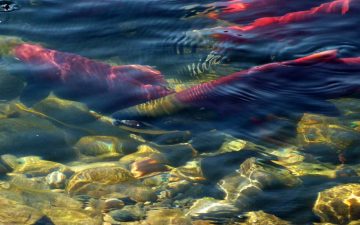
Sockeye salmon. / License: CC0 Public Domain
Developed as part of Project Salmon Resilience, a larger undertaking that aims to explore the impacts of fisheries and climate change on salmon populations, this database will fill gaps in scientists’ understanding of the late marine phase of the salmon life cycle, which is challenging to study at a large scale because of the long distances salmon swim from shore when they leave rivers and streams and enter the ocean.
“The diet database gives us a window into the lives of these salmon as they travel thousands of kilometres and experience different ecosystems and conditions,” said Caroline Graham, a graduate of the IOF’s Master of Science program who built the database as part of her Master’s thesis. “It’s about fitting the puzzle pieces together to see what conditions these fish face in the open ocean, and answering questions like: what food is available for them? is there competition for this food? how does this relate to environmental variability and salmon returns?”
Data for the database came from published, peer-reviewed studies and “grey” (non-peer reviewed) literature from countries across the North Pacific. Graham spent months combing through papers, extracting the data from them, and then translating the data into a standardized format that could be used to draw inferences about salmon, as well as be replicated for use in diet data collection for other fish species. To gather some data from places, such as Russia, the team had to negotiate with overseas agencies and hire translators to make sense of fish research and documentation. The work has already paid off by giving Graham some insights into salmon behaviour.
“What we’re seeing is that different species of salmon have different dietary habits. These differences tell us a lot about not only the ocean conditions but also competitive interactions between species of salmon, and how this plays out on a spatial scale,” Graham said.
Ultimately, the creators of the database hope that researchers collecting diet data on salmon in the North Pacific will add their findings to it, and that researchers studying Pacific salmon and North Pacific ecosystems more generally can use it in their work.
“One of the objectives for this project was to help bring the community together and hopefully inspire collating more data into this database,” said Brian Hunt, assistant professor and UBC Hakai professor of oceanography at the IOF who worked on the project.
He added: “There are a lot of other species of fish out there. We’d like to expand this database to more species and liberate diet data that are lurking in the literature or with agencies to make it available to the community. Everyone talks about ecosystem-based management, and to do that you really need to understand the interactions between animals. Most of that happens through the food web, so we need to provide access to information. Hopefully this is a small step in that direction.”
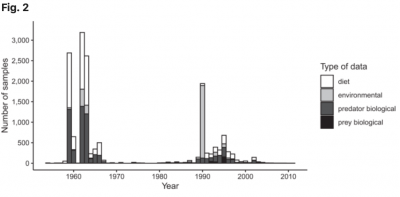 The number of samples for each type of salmon data reported between 1950–2011. |
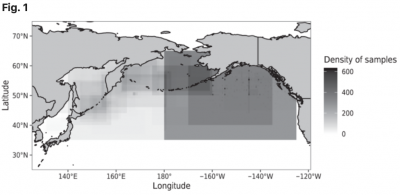 The spatial distribution of salmon diet samples across the North Pacific Ocean. |
Graham, C., Pakhomov, E.A. & Hunt, B.P.V. A salmon diet database for the North Pacific Ocean. Sci Data 7, 332 (2020).
Tags: Brian Hunt, Evgeny Pakhomov, faculty, food webs, IOF students, Pacific, Pelagic Ecosystems Lab, Research, salmon, species distribution
What’s Killing Killer Whales?
Orca report covering a decade of necropsies identifies threats

Southern resident killer whale J50 follows her mother, J16, in the Salish Sea in August 2018. (Photo: Katy Foster/NOAA Fisheries)
A study analyzing the reports was published today in the journal PLOS ONE. The study findings indicate that understanding and being aware of each threat is critical for managing and conserving killer whale populations. It also presents a baseline understanding of orca health.
The study was conducted by a team of marine mammal and orca specialists led by the British Columbia Ministry of Agriculture and coordinated through the SeaDoc Society, a Washington-based program of the University of California, Davis’ School of Veterinary Medicine. The lead author, Dr Stephen Raverty, and coauthor, Dr John Ford, are adjunct professors at the University of British Columbia Institute of Oceans and Fisheries and Department of Zoology.
The whales include those from healthy populations as well as endangered species, such as the southern resident whales regularly sighted off the coasts of British Columbia, Washington and Oregon.
“Half of the southern killer whale deaths identified in this study were caused by human interactions.”
Of 52 whales stranded between 2004 and 2013, causes of death were determined for 42 percent. For example, one calf died from sepsis following a halibut hook injury. Another starved from a congenital facial deformity. Two whales died from the blunt force trauma of vessel strikes. Additional causes of death include infectious disease and nutritional deficiencies.
‘We can do better’
Despite there being no singular common cause of death, the study found a common theme: Human-caused deaths occurred in every age class — from juveniles to subadults and adults.
“In British Columbia, we lost nine southern resident killer whales: 2 adults, 2 subadults and 1 calf died from trauma; one was a confirmed propeller strike, with one adult and two subadults from suspected ship strikes,” said lead author Stephen Raverty, a veterinarian pathologist with the BC Ministry of Agriculture and adjunct professor at UBC’s Institute for the Oceans and Fisheries. “One of these iconic species passed away from an infection secondary to satellite tagging. Another death was due to natural causes and the other two undetermined. Half of the southern killer whale deaths identified in this study were caused by human interactions.”

The 18-year-old male southern resident killer whale, J34, stranded near Sechelt, British Columbia on December 21, 2016. Postmortem examination suggested he died from trauma consistent with vessel strike. (Photo: Paul Cottrell, Fisheries and Oceans Canada)
In 2004, Raverty and Gaydos co-developed a standardized killer whale necropsy protocol. Revised in 2014 with help from Judy St. Leger, a pathologist working for SeaWorld, this guide helped improve examinations of deceased whales.
“The results from systematic necropsies of dead killer whales in this review is unique and will establish critical baseline information to assess future mitigation efforts,” Raverty said. “This work contributes to a better understanding of the impacts that ongoing human activities and environmental events have on killer whales.”
The authors acknowledge the report is an incomplete picture of orca health and mortality. Necropsies can only be performed on whales found in an adequate state to receive them, and even then, the cause of death cannot always be determined. But the report offers one of the most comprehensive looks yet at the multitude of human and environmental threats affecting killer whales and can help inform strategies to better protect them.
“Pathology findings and correlation with body condition index in stranded killer whales (Orcinus orca) in the northeastern Pacific and Hawaii from 2004 to 2013”, was published in PLOS ONE.
Additional coauthors include scientists from a wide range of institutions including Cornell University, National Oceanic and Atmospheric Administration, Alaska Veterinary Pathology Services, Marine Mammal Pathology Service in Maryland, UC Davis One Health Institute, Fisheries and Oceans Canada, Washington Department of Fish and Wildlife, Cascadia Research Collective, University of Illinois-Brookfield, Portland State University, and Oregon State University.
Funding was provided by NOAA Fisheries and multiple grants from the John H. Prescott Marine Mammal Rescue Assistance Grant Program. Additional support came from Fisheries and Oceans, Canada; Vancouver Aquarium Research Program; SeaDoc Society; SeaWorld; Animal Health Center of the BC Ministry of Agriculture; Washington Department of Fish and Wildlife; and numerous First Nations, Alaska Native, and Inuit communities.
Tags: British Columbia, Canada, cetaceans, conservation, faculty, killer whales, Marine Mammal Research Unit, Research, Stephen Raverty, whales, zoology
FCRR: Ecosystem modelling to support fisheries management efforts in the Nyali-Mombasa area, coastal Kenya
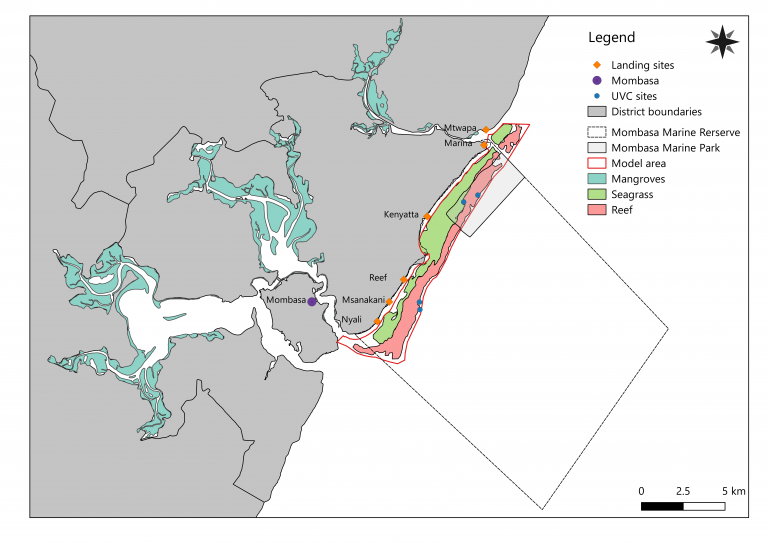
Anthropogenic and ecological impacts affect not only the environment, but also the livelihoods of the fishers and communities reliant on them. It is, therefore, crucial to study the entire chain of well-being for an ecosystem, from changing environmental conditions, to the impacts of humans and social processes, to the effect of high-level policies and ecosystem services. As part of the Sustainable Poverty Alleviation from Costal Ecosystem Services project (SPACES), this research addresses the important question: how can we best develop sustainable, effective fisheries decisions while preserving the livelihoods of fishers and their dependents?
This volume investigates the consequences from the effective ban of different fishing gears at Nyali-Mombasa, a site on the Kenyan coast. Using ecosystem modelling, it explores different scenarios for evaluating high-level impacts of various intervention or management decisions, as well as the resulting socio-economic consequences on relevant communities. The work has mapped various aspects of the Nyali-Mombasa ecosystem through the creation of a food web model, reproducing and quantifying main energy flows, and holistically investigating dominant food-web dynamics, and the role of fisheries on the system. With the exception of a simple Maputo Bay model (Silva et al. 1993), this research is the first to develop an Ecopath model for a coastal area in East Africa.
Specifically, the work described herein is intended as a preliminary step towards the estimation of the broad community, ecological, and economic effects of anthropogenic and ecological impacts on Kenyan coral reef ecosystems. Specifically, we sought to investigate the ramifications of the effective ban of different fishing gears at two specific locations along the coast of Kenya: Nyali-Mombasa (described here) and Vanga-Shimoni (described in a separate report). This initial step consists of the construction of a trophodynamic ecosystem model (using the freely available software Ecopath with Ecosim www.ecopath.org) for the locations of interest. Next steps will include simulations which might inform fisheries management decisions, as well as the identification of gaps in the data, and guidance for future research programmes.
- Ecosystem modelling to support fisheries management efforts in the Nyali-Mombasa area, coastal Kenya
- Fisheries Centre Research Reports page
Tags: Colette Wabnitz, CORU, East Africa, Ecopath with Ecosim (EWE), faculty, FCRR, fishing gear, food webs, IOF Research Associates, Kenya, Modelling, Publications, Research, William Cheung
China’s policy efforts to limit bottom trawling are not working
by Riley Tjosvold
A recently published paper by researchers at the Institute for the Oceans and Fisheries (IOF) tracked the changes in China’s bottom trawl fishing policies from the 1950s to today.
By analyzing policy changes over time, the researchers were able to highlight the difficulties of managing the bottom trawling industry in China, a country that operates one of the world’s largest networks of bottom trawling fisheries both in its own waters and off foreign coasts in Africa, Asia and Oceania.
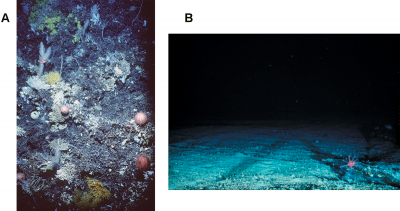
The Effect of Trawling the Seafloor for Groundfish. (A) The coral community and seabed on an untrawled seamount. (B) The exposed bedrock of a trawled seamount. Both are 1,000–2,000 meters (1094–2188 yards) below the surface. (Photo by CSIRO Marine Research.)
“China claims to lead sustainable fisheries development. Chinese leaders really want to make change so my intention with this paper is: if you want to make a change, you need to know about your history. What have you done over the past seven decades?” said Xiong Zhang, a postdoctoral research fellow with the IOF who led the study.
Since the 1970s, China has gradually implemented more sustainability-minded fisheries policies that, in theory, limit the amount of bottom trawling that can happen on China’s coast and elsewhere. However, the researchers found that these policy measures have not been effective at curtailing the harmful industry as compliance to them is likely low and China lacks a robust system of data collection for fisheries.
“There’s a growing demand for fish and for fishmeal to feed the agriculture. So, there is a strong incentive to still invest in bottom trawling. You cannot just stop bottom trawling entirely by ignoring the fact that the industry has incentive to grow,” Xiong said.
The paper also outlined steps that China can take to reduce its ecological footprint.
“One of my suggestions, or insights drawn from the history is that you have to get the attention of the general public, of the consumers, because they can drive change in the industry. They can motivate some of the top leaders to make change, to enforce the laws and policies. That’s a hope, that China may eventually move forward to sustainability,” Xiong said.
Tags: Amanda Vincent, bottom trawling, fisheries management, fishing gear, fishing practices, IOF postdoctoral fellows, Project Seahorse, sustainability, Xiong Zhang
SPOTLIGHT: Marine Mammal Energetics and Nutrition Lab carries on with research despite COVID-19 setbacks
by Riley Tjsosvold
Researchers with the Marine Mammal Energetics and Nutrition (MMEAN) lab are looking forward to continuing their work with marine mammals at the Vancouver Aquarium, even though access to lab facilities and animals in the aquarium’s care has been limited due to the COVID-19 pandemic.
Despite these setbacks, members of the MMEAN lab team produced two recent publications that appeared in The Canadian Journal of Zoology and Marine Mammal Science.
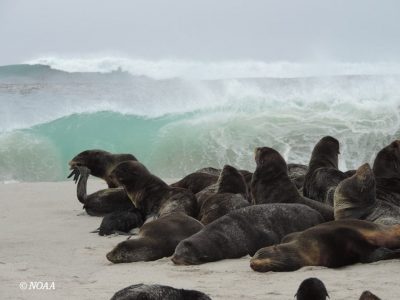
Northern fur seals
The study’s findings have implications for northern fur seal survival rates. Individuals within this species tend to specialize in their diets, with some foraging on food that is more fat-heavy and thus more beneficial to maintaining their health, while others feed on less ideal types of fish.
“If they eat food item A, then they have to eat 7 per cent more than if they’re eating food item B. That may not make a difference for most of the population, but when times get tough, especially for the animals in the population that are barely making it, that might make a huge difference in survival at the population level,” said David Rosen, an assistant professor at the Institute for the Oceans and Fisheries (IOF) and principal investigator of the MMEAN lab.
Rosen also led another recently published study on two juvenile walruses sent to the Vancouver Aquarium from Quebec. Rosen measured the resting metabolic rate (the rate at which an animal burns calories when not moving) and underwater swimming metabolism of the two Walruses. To get these measurements, Rosen and the Vancouver Aquarium training staff spent days coaxing the walruses to swim and then rest inside a chamber that measured the animals’ oxygen consumption. One surprising discovery: the young walruses had resting metabolic rates closer to those seen in adult marine mammals – an indication that walruses expend less energy when resting than researchers might expect.
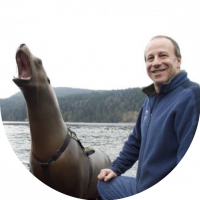
Dr. David Rosen
“The resting metabolic rate doesn’t take up too much energy. However, that is vastly overshadowed by how much energy they expend swimming,” Rosen said.
Walruses typically stay near their food sources — places like clam beds, for example. However, the ice that they rest on when they reach these food sources is melting, meaning that they are having to travel greater distances to eat.
“They still have to go to those foraging beds and they still have to haul out on that ice. So, it becomes further and further away that they have to do this. There’s no real way to offset that cost. It’s kind of a vicious circle, because they need to swim further to get that food, but they also need more of that food because they’re swimming further,” Rosen said.
Staying busy outside the lab
Rhea Storlund, a PhD student working in the MMEAN lab, has been away from the Vancouver Aquarium since March when COVID-19 caused research to shut down.
However, distance from the aquarium gave Storlund time to collaborate with a group of undergraduate engineering students to begin building an “inflation testing rig.” The device mimics the flow of blood through the heart and circulatory system of marine mammals, allowing Storlund to see up close the unique characteristics of the organ as it beats and pulses. This project has been temporarily put on hold.
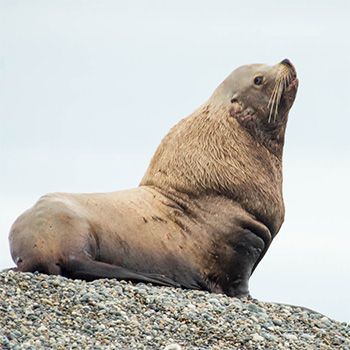 When she returns to the aquarium, Storlund hopes to test whether sea lions can consciously control their heart rates when they spend long periods of time underwater. She will use an echocardiogram (a device that produces an image of the heart using sound waves) to measure the sea lions’ heart rates while they do “trick dives” – a dive where the trainer prompts the sea lion to stay underwater longer than it expects before the trainer calls it back to the surface.
The research is important in helping to understand how well marine mammals can survive in changing habitats.
“If these animals are limited by how low their heart-rate can go, that affects how long they can stay underwater, which in turn has effects on what they can do in the wild, and where they can forage,” Storlund said.
On the horizon
With COVID-19 restrictions making travel to locations like Alaska more difficult, Rosen said that he plans to expand local field work.
“Vancouver is a really interesting place because we love our nature, but we also love our development, so we’re getting a couple studies off the ground looking at what that urbanization means to our local marine mammal populations,” Rosen said.
Additionally, he hopes to explore surprising marine mammal behaviours that researchers have been observing in the wild near Vancouver, like the re-emergence of certain dolphin populations and transient killer whales entering Vancouver waterways.
Although the COVID-19 pandemic has created limitations for scientists doing research in every field, Rosen remains optimistic:
“It just means we have to be creative to keep research going.”
Tags: British Columbia, David Rosen, faculty, IOF students, marine mammals, MMean Lab, Research, sea lions, seals
Dr. William Cheung awarded E.W.R. Steacie Memorial Fellowship
Dr. William Cheung, professor in the Institute for the Oceans and Fisheries, has been awarded a E.W.R. Steacie Memorial Fellowship.
E.W.R. Steacie Memorial Fellowships are awarded annually by The Natural Sciences and Engineering Research Council of Canada (NSERC), to recognize early-stage academic researchers and to support them to enhance their research capacity. Ultimately, the fellowship is to assist these researchers as they become leaders in their field and inspire others.
Dr Cheung is a Professor with UBC’s Changing Ocean Research Unit, Director (Science) of the NF-UBC Nereus Program and Canada Research Chair in Ocean Sustainability and Global Change (Tier 2). His main research studies the risks and impacts of fishing and climate change on marine ecosystems and their goods and services, and examine potential solutions to support ocean sustainability that reconcile the interactions between these impacts.
 “When I was a student in Hong Kong, I dreamed about becoming a marine scientist and making discoveries that could contribute to a better future for our world’s ocean. It is a remarkable journey to realize this now,” said Dr. Cheung. “This award will help expand my works and their impacts, as well as inspire others to pursue their career in science and to find solutions that address the urgent problems of climate change and other threats to our ocean.”
Internationally renowned, Dr. Cheung is highly effective in helping local and international communities understand how their actions are affecting the oceans, and informing policy and practice changes to ensure the sustainability of living marine resources. He was taking lead authorship role in various high-level international environmental science-policy assessments including those for the Intergovernmental Panel on Climate Change (IPCC), the Intergovernmental Platform on Biodiversity and Ecosystem Services (IPBES) and Global Biodiversity Outlook. He also serves as associated editor for Global Change Biology and Frontiers in Ecology and the Environment, member of the editorial board of Fish and Fisheries and Fisheries Oceanography, and as scientific advisors in a number of international and local organizations including the IUCN, Ocean and Climate Platform and Ocean Wise.
By receiving this award, Dr. Cheung will undertake a research project entitled, “Boosting resilience of marine ecosystems to climate change challenges.” The project will develop knowledge to identify general principles for designing climate adaptation intervention through marine protected areas, fisheries and conservation management to reduce climate-risks in the ocean. It will develop new data-infrastructure and innovative coupled human-natural system modelling to explore effective ways to facilitate climate adaptation for marine social-ecological systems. Dr. Cheung hopes that the outcomes will improve our understanding of the effectiveness of interventions to boost adaptation of marine systems and provide critical knowledge for policy discussion on ocean-based climate solutions in Canada and elsewhere.
“With climate change already impacting our ocean and the dependent human communities, everything from our seafood choices to policies on protected areas need to adapt to get us through these climate impacts before we successfully mitigate greenhouse gases emissions,” said Dr. Cheung. “This award will help me and my research team discover ways that we can do climate adaptation effectively in the ocean.”
UBC announcement
NSERC release
Tag: awards, CORU, William Cheung
Q & A: The EU needs to end its provision of harmful fisheries subsidies
by Riley Tjosvold
The European Union is re-evaluating where it allocates subsidies that go to fisheries and fishers. These changes will come at a time when fish populations globally are expected to shrink and when developing a robust sustainability plan to grow fish stocks is essential.
However, some researchers fear that the EU, despite its best efforts to meet the Sustainable Development Goals of the United Nations, will backslide and provide subsidies that encourage overfishing.
A recently published paper in the ICES Journal of Marine Science tracked the evolution of fisheries subsidies in the EU over the past 20 years. The authors argued that although the EU has increased its provision of beneficial subsidies, it still needs to cull a great number of harmful ones.
Daniel Skerrit
What the EU has done in terms of fisheries subsidies in the past?
Every few years the EU evaluates its funding and financing to establish what it aims to achieve and improve. You get these steps in changes over time. The fundamental aim has always the same, which is to have sustainable fisheries that are economically viable, that support the fishers and provide food for European citizens. They have gradually tried to emphasize ecological and environmental sustainability.
On paper what the EU have done over the past 20 years is great. They’ve been slowly moving towards what you might think is a more sustainable fishing sector. But in reality, every iteration of this funding mechanism has failed to achieve the EU’s objective. The objective is to have fishing that is in line with ecosystem limits, that is sustainable. And that still isn’t the case. There’s been slow progress but they still aren’t achieving what they set out to achieve. That’s what made me want to write the paper.
Why was it important to do this retrospective now?
There’s a lot of talk in the European Parliament and the European Council about trying to bring back fisheries subsides that are demonstrably negative to marine ecosystems and fish stocks.
One of the issues that often arises when I talk about EU fisheries subsidies is that people think you can provide harmful subsidies if your fish stocks are sustainable. And even if that were true, the EU fish stocks still aren’t sustainable. There are still numerous fish stocks that are below this point that everyone seems to have agreed is the level of sustainability.
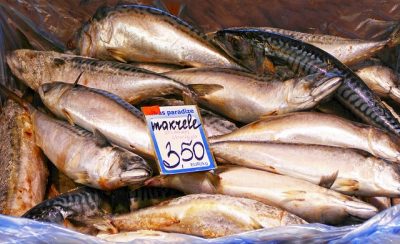
Freshly caught mackerel in a European market. Image by Wolfgang Eckert from Pixabay
What types of fisheries subsidies continue to cause harm to sustainability efforts?
Subsidies to modernize fishing vessels are one example. The objective might be to replace old engines on fishing vessels with newer, more fuel-efficient engines to reduce global warming. Great on paper, but what happens when you fit vessels with these more efficient engines is that they can fish further, and longer, they can fish more for the same fuel price. What you’re actually doing is making a more effective fish-killing machine. The difficulty with fish subsidies is the unintended consequences. The objective may be sustainability but the execution fails.
What recommendations would you make to the EU members as they decide where to allocate subsidies?
Don’t bring back subsidies you already got rid of. Don’t provide support or harmful subsidies to fisheries that are fishing on unsustainable stocks, and third, remove some of the most egregious subsidies — like fuel tax subsidies — and replace them with investment in things like marine protected areas or fisheries management.
What do you want EU citizens and stakeholders in the fisheries sector to take away from this paper?
We still believe that the fishing sector and the fishing community should be supported but we think that there are better ways to do that; ways that have a long-term vision
The problem with harmful fisheries subsidies is that although they might support job security and raise income, they’re really shortsighted. They undermine a renewable resource that is technically owned by everyone. Fishing can’t exist without the fish.
Tags: Daniel Skerritt, Europe, faculty, fisheries management, IOF postdoctoral fellows, Rashid Sumaila, subsidies