Jellyfish researcher Jessica Schaub to take “international tour” thanks to Hugh Morris Fellowship
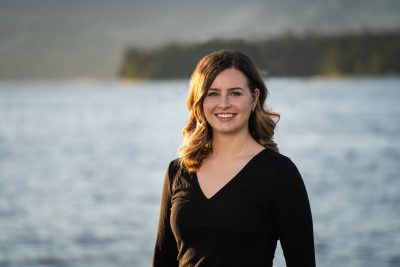 Institute for the Oceans and Fisheries (IOF) and Earth, Ocean and Atmospheric Sciences (EOAS) PhD student Jessica Schaub has been awarded the Hugh Morris Fellowship. This unique fellowship, administered by the Kimberley Foundation, will enable Schaub to take a tour of four countries, where she will work with specially chosen research partners who will deepen her understanding of jellyfish.
The fellowship, worth $40,000, is given to one or two Canadian graduate students a year and allows them to “undertake a program of self-guided travel and experiential learning.” Students must be researching a priority area related to Earth Sciences.
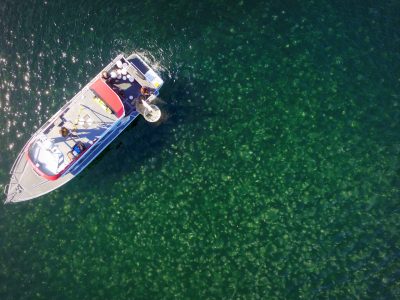
Schaub explores moon jellyfish (Aurelia aurita) bloom near Calvert Island, using a drone. ©Jessica Schaub
“I am just starting my PhD, so this fellowship came at a perfect time,” Schaub said. “I still have some flexibility to decide where my research will go, which will allow me to maximize the outcomes of this experience.”
Starting this July and ending in June of next year, Schaub will journey to Hiroshima, Japan; Montpellier, France; Mar del Plata, Argentina; and Exmouth, Australia, spending at least two weeks and perhaps up to a month in each location.
In Australia, she will study venomous Irukandji jellyfish on the Ningaloo Reef. In Japan, where blooms of jellyfish have created problems for local fishers, she will tour an edible jellyfish fishery in the Ariake Sea. And in Argentina and France, she will participate in fieldwork and experiments exploring the early-life “polyp” phase of the gelatinous sea creatures.
“The main focus is trying to understand jellyfish blooms, but centred around this idea that jellyfish blooms can have strong human impacts in some areas of the world, and I have to go outside of Canada to fully experience that,” Schaub said.
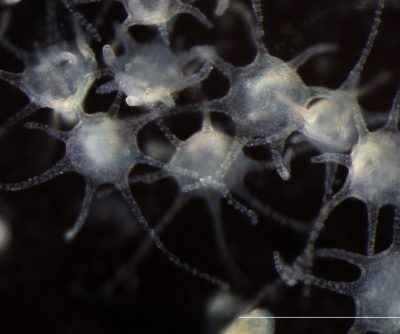
Moon jellyfish polyps ©Jessica Schaub
Schaub hopes to end the journey with a deeper understanding of jellyfish, and have an opportunity to share that with others.
“I’d like to turn this experience, and all of the cool media it will produce, into something that can engage schools and youth and get people excited about science, especially Indigenous people, young women and girls,” said Schaub, who is Alberta Métis, and has served as a mentor for UBC’s Indigenous Undergraduate Research Mentorship Program, as well as working teaching science to youth in northern Indigenous communities.
She is considering doing a podcast or a multimedia project that could be used as educational material.
“It could also be memorabilia of my trip, so I can go back and listen to in ten years and rekindle some memories.”
Related stories:
- Shedding light on mysterious jellyfish diets, October 14 2021
- HCI Marine Food Webs – Summer sampling trip to Quadra Island, September 19, 2019
- UBC researchers use drones to track jellyfish blooms, February 5, 2018
Tags: awards, IOF students, jellyfish
New FCRRs: Historical Ecology in Burrard Inlet and Reconstructing the pre-contact shoreline of Burrard Inlet
To understand our present and envision the future, we must also understand our past.
These two new Fisheries Centre Research Reports will help us understand the overpowering changes that colonial settlement and development has had on the marine ecosystems surrounding the Lower Mainland area of British Columbia. Today, we are seeing these accrued impacts in severe, long-term effects on ecosystems and physical environments, and on the lifeways, cultural practices, and traditional diets of Indigenous communities, particularly Tsleil-Waututh Nation, who have lived in this coastal area since time immemorial.
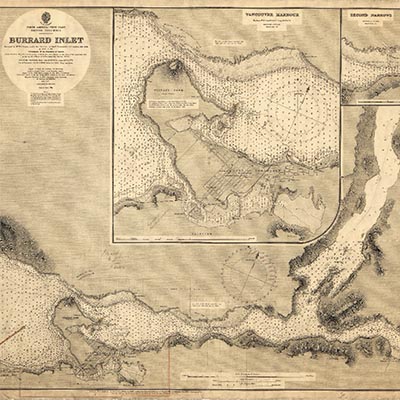 The first, Reconstructing the pre-contact shoreline of Burrard Inlet (British Columbia, Canada) to quantify cumulative intertidal and subtidal area change from 1792 to 2020, looks at how colonial development has severely altered landscapes, including in Tsleil-Waututh Nation’s (TWN) territory, centred on present-day Burrard Inlet, BC, where urban and industrial expansion has modified the inlet’s shoreline for well over a century. These shoreline changes have degraded the ecosystem and affect TWN in innumerable ways, but non-Indigenous communities have not considered the impacts of total shoreline change in detail, and generally accept shoreline changes that have occurred since European contact as the “baseline” condition of Burrard Inlet. In this study, the authors used multiple lines of evidence to reconstruct the shoreline of Burrard Inlet as it existed prior to European contact in 1792 and quantified the spatial extent of intertidal and subtidal area change in the inlet from 1792 to 2020. The results demonstrate that, across Burrard Inlet, a total of 1,214 ha of intertidal and subtidal areas have been lost to development and change, including 55% (945 ha) of the inlet’s intertidal areas. The most severe shoreline alteration occurred in False Creek and the Inner Harbour, including loss and elimination of ecologically productive and culturally important intertidal habitats at False Creek Flats (>99% intertidal area lost), the Capilano River Estuary (80% intertidal area lost), and the Seymour-Lynn Estuary (56% intertidal area lost). This shoreline loss has fundamental consequences to Burrard Inlet’s ecosystem and TWN’s ability to exercise constitutionally-protected rights. Further, this work demonstrates that any potential future shoreline loss must consider historical shoreline change and cumulative effects in Burrard Inlet.
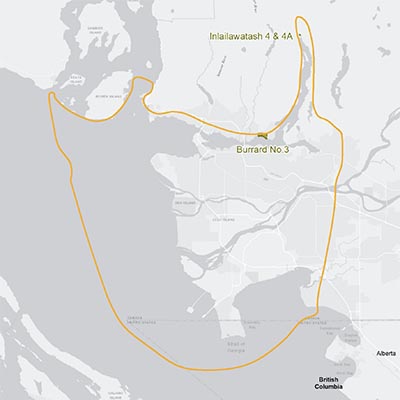 The second, Historical Ecology in Burrard Inlet: Summary of Historic, Oral History, Ethnographic, and Traditional Use Information, looks at the profound changes, undergone by the marine ecosystems surrounding the Lower Mainland area of British Columbia, resulting from poor fishery practices, pollution, and habitat destruction associated with the development of a large urban centre and Canada’s busiest port. To gain a better understanding of pre-contact ecological conditions in Burrard Inlet and surrounding waters, and to assess the scope and magnitude of negative impacts to key species, an extensive review of historic, archival, ethnographic, Traditional Use Studies (TUS), and other relevant materials was undertaken. This body of information provides unique insight into the past abundance of species across the study area and identifies key periods of change. Almost all of the taxa identified in the literature review displayed evidence for decreased abundance in modern compared to early historic times, and in many cases, this decrease was profound. Specifically, this review identified major population reductions of herring, smelt, eulachon, salmon, sturgeon, groundfish, clams, crab, whales, and waterfowl. For all taxa reviewed, save for cod, where the data make it possible to estimate, this review indicates that estimated current population abundances for focal species ranges from less than 1% to 50% of their mid-19th century and pre-contact levels.
We salute the authors of these Fisheries Centre Research Reports for their determination in helping us understand the shifting baselines in the Burrard Inlet and the Tsleil-Waututh Nation, and how they have challenged the ecosystems and peoples who live in this coastal area.
You can find both Reports here.
Tags: Aboriginal fisheries, birds, British Columbia, coastline, FCRR, fish, fish stocks, fishing practices, Indigenous fisheries, IOF students, ocean ecology, Publications, Research, Tsleil-Waututh Nation, Villy Christensen, whales
Partnership between UBC researchers, marine stewards and K’ómoks First Nation spawns new microplastics findings
Microplastic exposure increases in larger herring
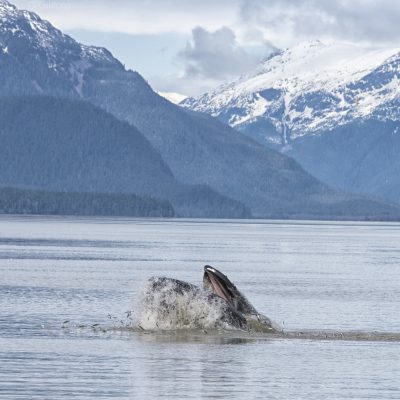
“Humpback whale eat herring” by Gillfoto. CC BY-NC-SA 2.0.
Dorrie Woodward, chair of the of the Association for Denman Island Marine Stewards (ADIMS), describes springtime along the island’s shores and nearby waters as a marine “Serengeti.”
“A core aspect of being a Denman Islander is that each year you go through this amazing natural event,” Woodward said. “We’re all pretty vigilant about the herring, and feel protective and passionate about their wellbeing.”
That is why, when a report suggested that Denman Island’s waters could be full of microplastics – bits of plastic, smaller than five millimetres, that may harm fish and human health – the ADIMS, along with the K’ómoks First Nation Guardian Watchmen mobilized to uncover how big the problem was, and what could be done about it.
They enlisted the help of researchers at UBC’s Institute for the Oceans and Fisheries (IOF), who, using local knowledge of the area provided by members of the K’ómoks Nation, plus the equipment and energy of various community members, set to work collecting and analyzing samples of herring larvae, juvenile herring, and zooplankton.
What they found helps illuminate the study of microplastics in the ocean, an area of pollution research that is garnering lots of attention due to the many unknowns about how these particles damage the health of organisms that ingest them.
“The consumption of microplastics was surprisingly low in zooplankton and larval herring,” said Natalie Mahara, the lead author of a recently-published study and a graduate of the IOF’s master’s program. “The presence of microplastics became much more obvious when we looked at juvenile herring. The biological particles, like phytoplankton, that zooplankton eat are tiny. The natural prey of zooplankton and larval herring is incredibly abundant, and their chances of coming across similar sized microplastic particles are therefore very slim. But if you’re eating larger zooplankton, like juvenile herring do, you’re going to come across microplastics more frequently. The probability of ingestion increases with organism size, because the ratio of plastic to natural prey is higher.”
These findings suggest that juvenile herring have greater exposure, and potentially vulnerability, to microplastics than larval herring.
The research team expected to find larger amounts of microplastics in the water near towns and near shellfish fisheries. However, the tiny particles appeared in roughly the same concentrations in all of the sampled areas, regardless of proximity to the human settlements where plastic pollution originates.
“The tides are intense in this area, with currents moving all over the place,” Mahara said. “We’ve put a lot of microplastics into the environment and they get swished around; they get distributed easily. It was the same for the vertical distribution in the water column; they were spread evenly everywhere.”
Most microplastics identified by the study came from polyester fibres, likely shed from clothing in the laundry. Installing additional filters in laundry machines could stop some of the particles from entering the ocean, Mahara said.
Woodward said that she was relieved when the study’s results came back less dire than she anticipated.
“It takes something that was a threat or an emergency away, which allows us to focus on other concerns for sensitive habitat, since the shellfish growing industry is very active here in Baynes Sound,” she said, and added that she hopes the community can continue to work with scientists to assess these marine pollution threats over time, now that a baseline has be established.
However, the higher amounts of microplastics in juvenile herring do leave her concerned. “To me, it means that more work needs to be done,” she said.
Dr. Brian Hunt, the study’s senior author and an assistant professor at the IOF, agrees with Woodward’s cautionary words.
“There are still a lot of unanswered questions around the potential impact of microplastics on our marine ecosystems, and more needs to be done to understand them,” Hunt said. “Two areas of concern emerged for me during this study. One is all of the plastics we are not able to measure with current methods; particles smaller than microplastics that can be deposited or absorbed into an organism’s tissues. The other is all of the non-plastic particles that we found that looked like plastic. These particles, appear to be mostly material fibres, likely from human products. Of concern is the potential effects of chemicals or additives from these fibres, linked to treatments during material production, on our coastal food webs.”
The research also points to potential bioaccumulation pathways for microplastics though the food web in Baynes Sound and the Strait of Georgia, said co-author and IOF Research Associate Dr. Juan José Alava, who leads the Ocean Pollution Research Unit at IOF.
“The findings highlight the implications for the plausible bioaccumulation of microplastics in top predators such as sea lions, seals, and seabirds, as well as filter-feeding megafauna, including baleen whales foraging on Pacific herring, which is one of the most fundamental trophic level links to sustain the regional food web, the subsistence fisheries, and traditional seafoods of coastal communities in B.C.,” Alava said. “An additional topic deserving further attention and research is the short term (acute) and long term (chronic) toxicity caused by plastic particles per se in marine organisms.”
The study “Assessing size-based exposure to microplastic particles and ingestion pathways in zooplankton and herring in a coastal pelagic ecosystem of British Columbia, Canada” was published in the journal Marine Ecology Progress Series.
Tags: Aboriginal fisheries, Brian Hunt, British Columbia, coastline, faculty, herring, Indigenous fisheries, IOF Research Associates, Juan Jose Alava, Pelagic Ecosystems Lab, plankton, plastic, pollution, Research, zooplankton
In Memoriam: Jeffrey Hutchings

By Alexfern – Own work, CC BY-SA 4.0
Jeff himself had emphasized his role as an “advocate for independent fisheries research” in a recently published autobiographical piece in the ICES Journal of Marine Science2. However, we should realize that his advocacy was rendered legitimate, as it should, by a sound basis of technical competence.
Specifically, Jeff very early on understood that depleted fish populations – including the Northern cod in Eastern Canada – at low population size suffer from a reduced ‘intrinsic’ population growth rate ‘r’, a phenomenon variously labeled “Allee effect” or “depensation.” In other words, r is not really ‘intrinsic’ to a fish population: it also depends on its abundance, at least when its low. This concept, masterly presented in Nature3, was an important contribution to fisheries science, reflected in the fact that depensation is built in most of the stock assessment models in current use. Jeff was quite aware of the importance of this phenomenon, which is the focus of one of the last papers he co-authored.
One feature of crises of various sorts is that they allow people – including scientists – to shine, or not. Two Canadian crises gave Jeff importunities to shine. One was the collapse and closure of the Canadian fishery trawling for cod, reportedly the best-managed fishery in the world, and whose demise was blamed by the DFO bureaucracy on “ecological factors” such as seals and cold waters. This, however, did not consider the fact that cod has been successfully exploited for 450 years by European and Canadian fishers, despite seals and cold waters.
Jeff and his colleague, R.A. Myers, then both with DFO, challenged their employer’s position. They both had to find refuge at Dalhousie University, but they won the argument: we now know, not least thanks to their efforts, that the cod stock was dreadfully overfished, and it has become an exemplar for how not to run a fishery.
The second crisis that allowed Jeff to shine was the largely successful attempt by the previous Harper government to muzzle scientists and sideline science in policy making generally. In various countries – especially the USA – we can see the damage that decisions of this sort can inflict to a society. Jeff was a leader in Canadian scientists’ successful public protests against this policy4. Jeff should be, and hopefully will be, a role model for young scientists: technically competent, courageous, yet modest, a “mensch.”
We will miss him.
Dr. Daniel Pauly
University Killam Professor, Institute for the Oceans and Fisheries
Dr. William Cheung
Professor and Director, Institute for the Oceans and Fisheries
Dr. Marie Auger-Méthé
Assistant Professor, Institute for the Oceans and Fisheries
Dr. Villy Christensen
Professor, Institute for the Oceans and Fisheries
Dr. Simon Donner
Professor, Institute for the Oceans and Fisheries & Institute for Resources, Environment and Sustainability & Department of Geography
Dr. Chris Harley
Professor, Institute for the Oceans and Fisheries & Department of Zoology
Dr. Brian Hunt
Assistant Professor, Institute for the Oceans and Fisheries
Dr. Dianne Newell
Professor Emeritus, Institute for the Oceans and Fisheries
Dr. Evgeny Pakhomov
Professor, Institute for the Oceans and Fisheries & Department of Earth, Ocean and Atmospheric Sciences
Dr. Tony Pitcher
Professor Emeritus, Institute for the Oceans and Fisheries
Dr. Andrea Reid
Assistant Professor, Institute for the Oceans and Fisheries
Dr. David Rosen
Assistant Professor, Institute for the Oceans and Fisheries
Dr. Rashid Sumaila
University Killam Professor, Institute for the Oceans and Fisheries & School of Public Policy and Global Affairs
Dr. Andrew Trites
Professor, Institute for the Oceans and Fisheries & Department of Zoology
Dr. Amanda Vincent
Professor, Institute for the Oceans and Fisheries
Dr. Carl Walters
Professor Emeritus, Institute for the Oceans and Fisheries
1. Tutton, M. 2022. Jeffrey Hutchings – Teacher, Scientist, 63. The Globe and Mail, B16, 2 Feb. 2022.
2. Hutchings, J. 2022. Tensions in the communication of science advice on fish and fisheries: northern cod, species at risk, sustainable seafood. ICES Journal of Marine Science https://doi.org/10.1093/dasab271
3. Hutchings JA. Collapse and recovery of marine fishes. Nature. 2000 Aug;406(6798):882-5.
4. Hutchings, J. 2013. Harper government’s muzzling of scientists a mark of shame for Canada. The Toronto Star, March 14, 2013.
UBC scientists sail the high seas for salmon
The third International Year of the Salmon Pan-Pacific Winter High Seas Expedition will continue to answer questions about a crucial salmon life stage that is poorly understood
Four research ships, on a mission to understand how salmon are handling perilous winters in the open-ocean stage of their life cycle, set sail this month. Departing from locations in Canada, the United States, as well as Vladivostok, Russia, an international team of scientists will collect samples of marine life and research physical, biological, and chemical processes in the upper ocean in what is one of the largest Pacific Ocean surveys to ever be undertaken in the winter.
The team intends to build upon discoveries made during two previous International Year of the Salmon (IYS) expeditions into the Gulf of Alaska in 2020 and 2019. This year’s expedition adds more people, more ships and more ocean coverage, and it will hopefully produce the most substantial findings of the three, according to Caroline Graham, High Seas Coordinator for the IYS, and a graduate of the IOF’s Master’s program.
“I would say all the work done over the last five or six years for IYS and these Gulf of Alaska expeditions, it’s all been building towards this,” Graham said. “It’s been a long road to bring people on board, get the funding we needed to make this happen, and we are very excited to see the results of this effort.”
The previous voyages, which also involved UBC scientists, found salmon from rivers across the North Pacific “hanging out together” in the Gulf of Alaska, and detected the DNA of potential salmon predators such as the salmon shark, said Graham.
Scientists aboard this year’s expedition ships will tackle different research areas, including physical oceanography, genomics, and the food web, on a journey that spans the western North Pacific, all the way to coast of Canada and the U.S., and into the high seas of the Gulf of Alaska.

Chief Scientist Dr. Evgeny Pakhomov boards 2019 IYS research ship
Roughly 80 to 90 per cent of salmon die as they journey from lakes and rivers into the ocean. A large majority of the surviving 10 per cent perish in the high seas, according to Pakhomov, but scientists don’t know what exactly is killing them.
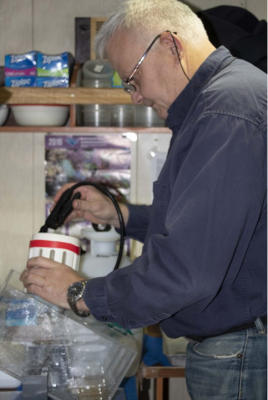
Dr. Evgeny Pakhomov washes plankton samples during the 2019 IYS expedition ©Chrys Neville
“We’re trying to understand where this mortality happens and also what happens. Is it related to predation? Is it challenges surviving the first winter?” Pakhomov said. “Where do they forage? What do they eat? Do they travel individually, or in schools? Do they have enough food? Do they compete with each other for food? Where are certain populations going? This provides an opportunity to answer these questions, to open this black box and see what is inside.”
Pakhomov, whose main interest is zooplankton and food webs, will board the Russian ship R/V TINRO on Feb. 21 at Dutch Harbor, Alaska and spend the next three weeks working day and night to collect, process and analyze samples caught in the ship’s trawls. He will be relieved by UBC postdoc Dr. Elliott Price, and PhD student Jacob Lerner, who will stay aboard the TINRO until its visit to Dutch Harbor on April 8 before returning to Vladivostok, Russia on Apr. 24.
“This expedition is a different beast,” said Lerner, who had been aboard the 2020 expedition. “The North Pacific in March, the intensity of these cruises, the amount of people involved, the amount of international collaboration involved — this is a step above in terms of what we’re trying to accomplish.”
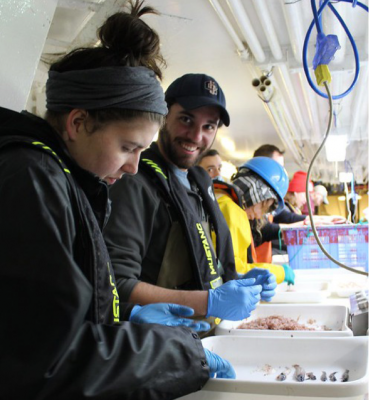
IOF’s Natalie Mahara and Jacob Lerner checking samples on the Gulf of Alaska 2020 expedition. ©Svetlana Esenkulova
“It’s all fascinating, and I can’t wait to see it come together,” Lerner said. “I don’t want to speculate too hard, but I think we’re going to encounter some very important stocks of salmon. It will be interesting to see how full their stomachs are, how healthy they are, and to learn what the trophic structure of this ecosystem looks like.”
Also taking part in the voyage are postdoctoral fellows Dr. Genyffer Troina, who will be on the Shimada (US vessel), and Dr. Anna McLaskey, who will be on the Franklin (Canadian vessel).
Pakhomov said that, for him, the most important parts of the expedition are the high level of international collaboration and the opportunity to train a new generation of ocean scientists
“It is nearly impossible for one country both logistically and financially to achieve such geographical coverage and the international collaboration is a solution. The more we show we can collaborate between countries, the more we start sharing information which we already have and which we will be able to collect,” he said. “I would like to think this will be the first of many collaborations like this.”
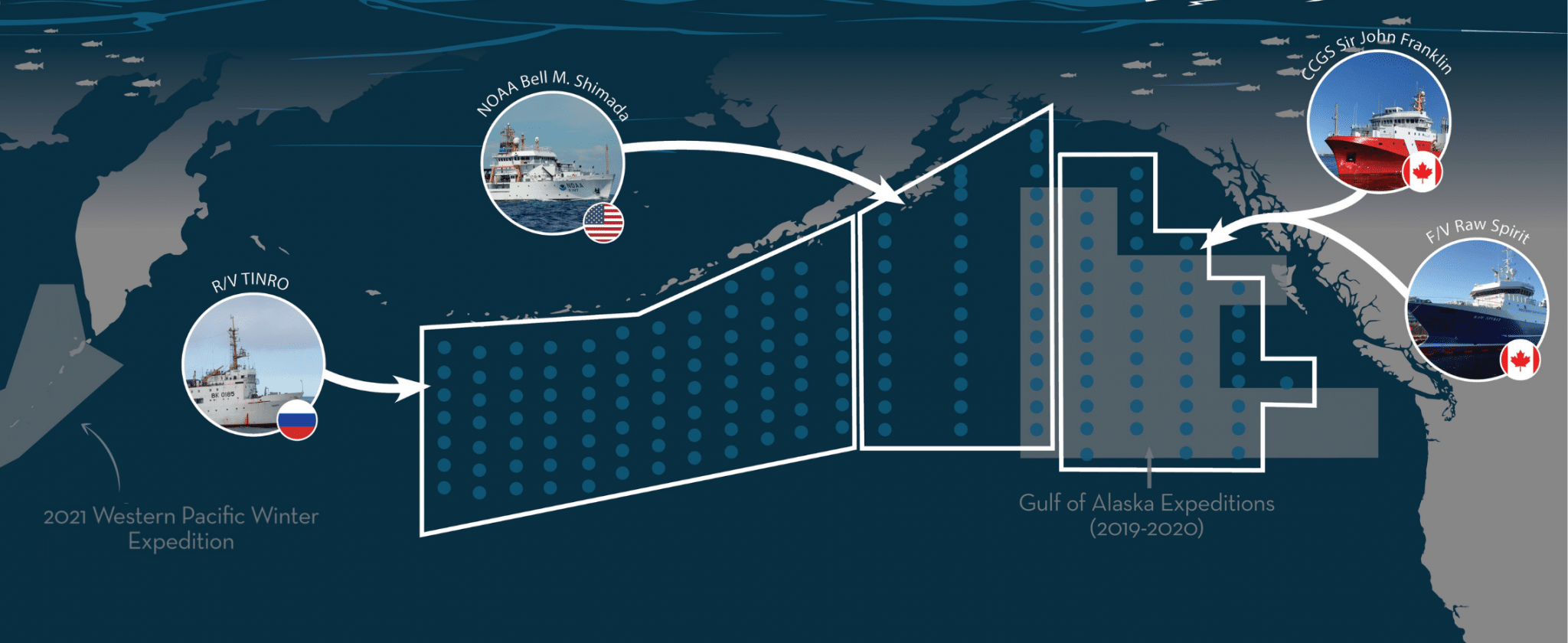
Zone map for the 2022 Pan-Pacific Winter High Seas Expedition