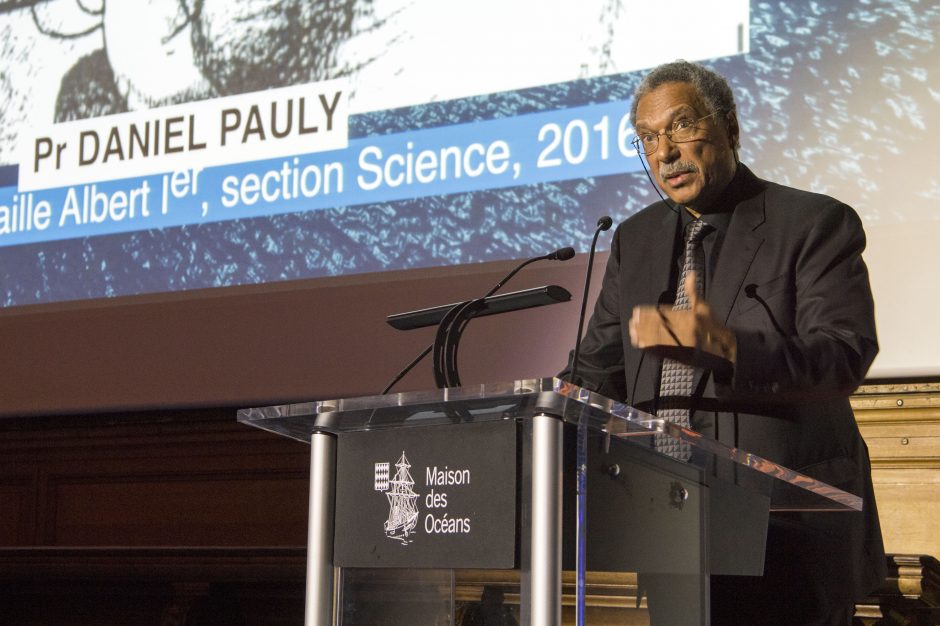
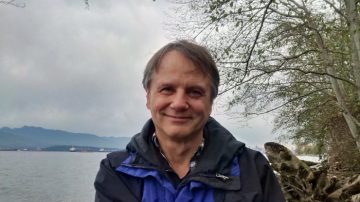
Daniel Pauly. Photocredit: M. dagnino – Institut océanographique
May 29, 2019
The Sea Around Us is a research initiative at the University of British Columbia, located in the Institute for the Oceans and Fisheries (IOF), which assesses the impact of fisheries on marine ecosystems worldwide, and offers mitigating solutions to a range of different stakeholders.
Daniel Pauly, the principal investigator of Sea Around Us, is a world-renowned marine biologist, a professor in IOF, and author of the recently-released book “Vanishing Fish: Shifting Baselines and the Future of Global Fisheries“. For World Oceans Day 2019, we sat down with Dr. Pauly and ask him a little bit about Sea Around Us and what he hopes to achieve with his work.
What are some of the things that Sea Around Us is studying?
We believe that the most important thing you can know about a fishery is its catch. This might seem trivial because it sounds like we always know the catch of a fishery, but that’s not the case at all. There are fisheries whose catches are not known, or whose catches are underestimated or overestimated. And this under- and overestimation leads to inaccurate assessments of the situations that fisheries are in.
Second, once we have accurate catches, which we have reconstructed in many cases, we can infer other information, like the abundance of the fish in question. Or we can combine this information with the size of the fish that are caught to extrapolate on processes that are changing in the ecosystem. In other words, we can derive new statistics from the catch. But the catch itself is essential.
What else does Sea Around Us do?
There is an immense amount of fisheries data that are usually not available to the public, and we make that information available on our website. We also publish in academic and other outlets.
What do you hope to accomplish with your research and with Sea Around Us?
To empower groups that want to do something about the situations around fisheries. I hope to enable people with data and concepts from our research, and from the fisheries data we have provided online, so that they can present alternatives to the present fisheries situation and help make better choices about fisheries management.
Having these concepts, methods and findings is, again, empowering because they allow people to question the standard way of going about things and the management systems that have been implemented by various countries, many of which are not working. Empowerment is really the name of the game.
What sparked your interest in fisheries science?
For that, we have to go back to the ‘70s. I studied in Germany, and for a number of personal reasons I ended up with fisheries and oceanography as my subjects of study. But really, the conversion occurred between my Masters and my PhD when I was in Indonesia. I was confronted during a trawl survey with lots of different fish species, and none of the books I was consulting knew what to do about them. I felt I had to reinvent much of fisheries science for its concepts to be applied to the tropics, and in a sense, I have.
If there is one thing you want people to take away from your research, what would it be?
That you can reverse and improve things at all stages, even when they are in a bad state.
Read more about Daniel Pauly on the Sea Around Us website
Tags: Daniel Pauly, faculty, fisheries management, marine catches, Research, Sea Around Us




 The Wall Scholars Research Award is available to UBC Faculty members to spend one year in residence at the Institute in a collaborative, interdisciplinary environment.