
Q&A with MSc Student Vanessa Fladmark
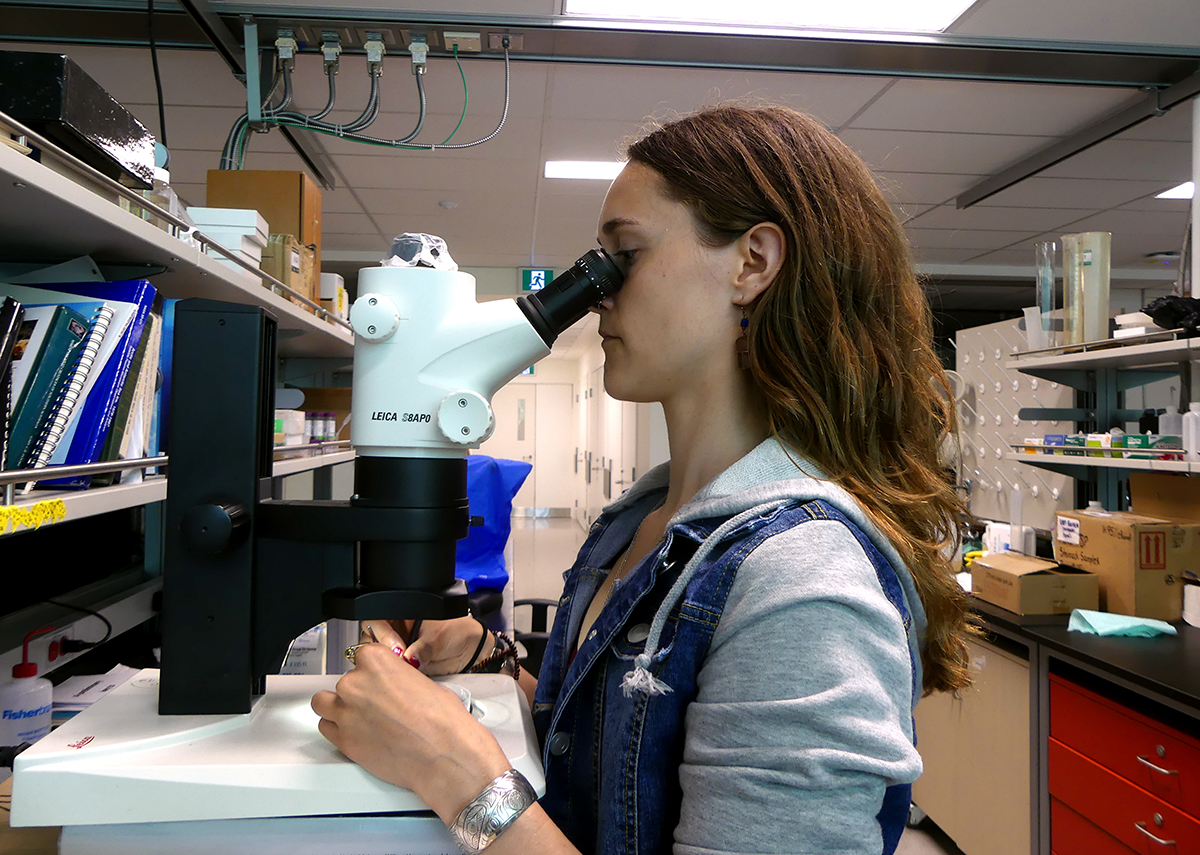
Vanessa Fladmark working at a microscope.
Meet student Vanessa Fladmark, a Masters student, oceans outreach enthusiast and professional salmon stomach detective. She is mainly at the Marine Zooplankton and Micronekton Laboratory of the Department of Earth and Ocean Sciences but is also connected to the Pelagic Ecosystems Lab and UBC’s Institute for the Oceans and Fisheries (IOF).
Coming to UBC from Haida Gwaii, Vanessa studies juvenile pink and chum salmon and what they eat in BC’s coastal waters – by looking at their stomach contents.
Tell us about yourself.
My name is Vanessa Fladmark, and I’m from the Haida Nation on Haida Gwaii. I’m currently a second year Masters student working with Evgeny Pakhomov and Brian Hunt, pursuing a degree in biological oceanography.
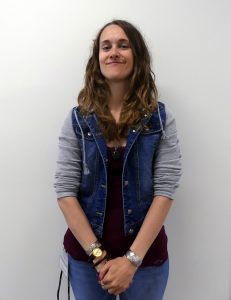
Vanessa Fladmark.
What are you researching?
I study juvenile pink and chum feeding ecology in coastal British Columbia, focusing in the area around the Discovery Islands and the Johnstone Strait. This involves looking at their feeding during the first couple months at sea, after they migrate through the Strait of Georgia. I look at this specifically with a bottom-up focus; investigating their stomach contents to determine what the salmon were eating and what zooplankton would have been available in the water.
My main research questions involve comparing areas of different productivity, and how pink and chum salmon are interacting and feeding under different conditions. For example, what are these species foraging for when the abundance of zooplankton in the ecosystem changes? Do they compete with each other or do they occupy different niches, which limits competition between species? How are they behaving when different zooplankton communities exist in the water? Those are some of the things I’m looking at.
What tools or techniques do you use to study salmon stomachs?
I use a microscope to look at the stomach contents of juvenile salmon and identify, count, measure, and weigh all the different things they’ve consumed, from zooplankton to microplastics to other fish. I get to see not only what they are eating, but how much they consume.
While I can assess this visually, there is also a calculation that helps me determine how much salmon are consuming compared to their body weight. I’m still analyzing the data now, but so far in some areas we’re seeing that some salmon are eating a lot, more than 100% of their stomach’s fullness, while in other areas their stomachs are pretty empty. It’s interesting because what and how salmon eat can be really, really diverse across the ecosystem.
Where do you get these salmon samples from?
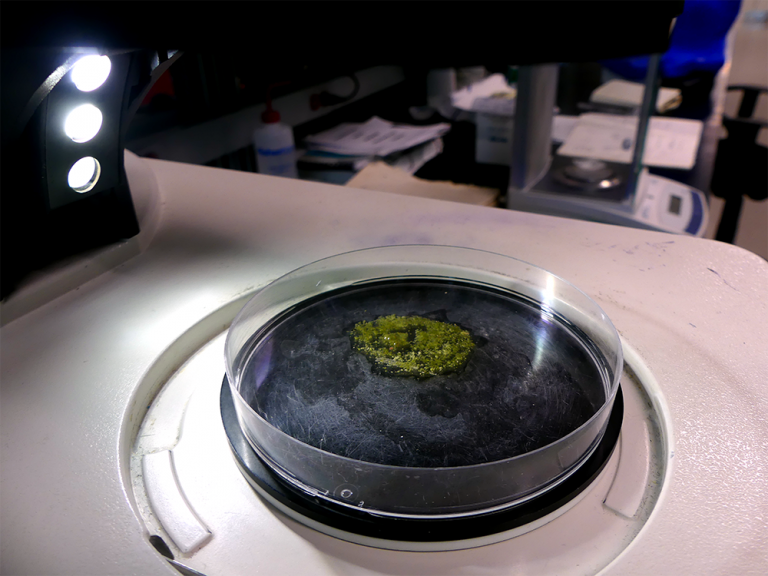
Echinoderm larvae from a salmon stomach.
We are partnered with the Hakai Research Institute up on Quadra Island, which has a Juvenile Salmon program where they collect salmon every year. Typically, during the salmon’s main outmigration period in May through to July, they collect and dissect sockeye, pink, chum, and a little bit of chinook, Coho, and herring. Fish are assessed for parasites and samples like scales, otoliths, muscle tissues, and stomachs are collected. After this, I get access to samples for the years I’m evaluating – 2015 and 2016.
Hakai also takes zooplankton tows, which provides me with information to evaluate which organisms are in the water, compared to what the salmon are actually eating. I can see if the salmon are picking out certain organisms in the water to consume, or are avoiding other organisms.
Why did you choose this research area in particular?
I did a Directed Studies course in my undergrad with Evgeny Pakhomov, looking at fish diets but in surf smelt, herring and anchovies. I thought it was really cool, weird, and niche work to be cutting open fish stomachs. It’s fun to look at something and identify what type of zooplankton it is – kind of like being a detective.
Sometimes I see something and I’m like, “What is that? It’s got half of its body but I think I can still identify it…” It fits this puzzle and tells you what this fish experienced, and I find that really interesting.
Why study salmon, especially pink and chum?
I worked for a year in the lab under a Pacific Salmon Foundation grant and did work with all sorts of different species of fish. Salmon, I think, are particularly interesting. I picked pink and chum because they’re co-migrators of sockeye, which is the species people are usually really concerned about because sockeye are in decline. But nobody’s really looking at pink and chum, which are possible competitors, and it’s crucial to look at potential interactions between salmon species.
Salmon are so important: economically, socially, culturally, ecologically – in freshwater, ocean, and terrestrial systems. They’re at the centre of everything in B.C. And, being from Haida Gwaii, my people love salmon, and I want to be able to graduate and bring this knowledge back to my community.
What do the Marine Zooplankton and Micronekton Lab and Pelagic Ecosystem Lab investigate?
It’s hard to describe because our research is so diverse, but generally we’re looking at multiple levels and organisms rather than a single thing. There are people looking at jellyfish, biogeochemistry, using DNA genetic testing, and all sorts of things. A big focus is on food chains and the interaction of food webs – what’s eating what, and how that is influenced by bottom-up and top-down controls like the properties of the water and higher trophic predators, respectively.
What’s really cool about the salmon work we’re doing is that, overall, we’re looking at each life phase of salmon. Thomas Smith is looking at the freshwater phase, Samantha James and I are looking at the early marine stage, and Caroline Graham is doing a literature review on salmon diets in the open ocean. Boris Espinasse is looking at stable isotopes in salmon, which gives you a one-month long idea of what they’re eating by looking at their tissue, while stomachs give you a recent snapshot. There are a lot of different things that we’re looking at, and each person is kind of like a different piece of the puzzle.
My work really ties in with Samantha, who is also investigating salmon stomach contents in the years 2015 and 2016, but in sockeye. Eventually the idea is to compare our research and see how different salmon are feeding differently.
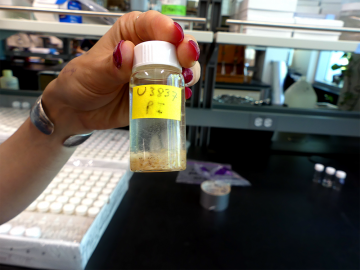
Stored stomach contents of a pink salmon, full of krill.
What are your favourite and least favourite things about your research here?
I really do enjoy fieldwork, even though I’ve been more lab-focused. But I’d also say a big part of it is the community that we have in the labs and at UBC. In both my labs, I get to collaborate with these brilliant people, talk about zooplankton and salmon with them, go to conferences together and so much more. It’s really great to have a bunch of brilliant friends so I’ll miss that when I graduate.
My least favourite is just living in the city, because I’m from a very, very small town. So that’s definitely the most challenging thing, being away from the community. In the city, there’s so many people and that can be overwhelming. It’s a tough juggling act: I get to learn cool things, but I’m not living where I want to be.
What do you like to do when you’re not doing research?
I actually do a lot of volunteering for ocean-related things, so even when I’m not in the lab doing my ocean research I’m out there talking to the public. I’ve talked with high school students and I’m really involved in shoreline cleanups like the Great Canadian Shoreline Cleanup; I’ve done like ten of those and that’s really become the thing I do for fun, going to the beach and picking up garbage with other people. As part of the Ocean Leaders course I took, we actually analyzed the data on cleanups in B.C., which was really cool.
Why do you do oceans outreach?
It’s one thing to study the ocean and to work in isolation in academia, and it’s another thing to reach out to people and be like, “This is what I’m working on and this is why it’s important, and here’s how you can help.” Outreach keeps me inspired to keep going through grad school when it gets really tough. Seeing other people getting excited about oceans research and talking about it reminds me why I’m doing what I’m doing, when I’ve been lost in the microscope for too long.
I also want to inspire more people to go into science, especially Indigenous students, because I’ve found it very challenging to move away from my community so I know how much of a struggle it is. It’s also difficult to put so much time into school when you could be in the community, making a difference on the ground. But I do believe education and creating networks are really worthwhile, because I want my community to be empowered to do even more Haida-led research and sustainable marine stewardship.
Tags: IOF students, plankton, Research, salmon, Shoreline cleanup

Marine protected areas can improve both human well-being and biodiversity conservation, new study finds
A new study finds that marine protected areas (MPAs) have the potential to help both the environment and people’s well-being, with positive and negative impacts often occurring at the same time, shedding light on a traditionally understudied area.
The study investigated how different aspects of human well-being are affected by the use of MPAs, marine regions that are legally protected and managed in order to protect natural resources and prevent biodiversity declines. While research shows that MPAs are effective for conservation, their impact on human well-being is less known.
“We found that marine protected areas often lead to improvements in human well-being,” said Dr. Nathan Bennett, a co-author of the study and Research Associate with the OceanCanada Partnership at the University of British Columbia’s Institute for the Oceans and Fisheries and at the Université Côte d’Azur. “Sometimes, however, MPAs can also produce negative consequences for local people. It is important to understand why these different outcomes are occurring.”
Reviewing a wide range of global research, the researchers examined how MPAs affected the social, health, culture, economic, governance and environmental domains of people’s well-being. This helped them uncover answers like how human well-being is usually defined and studied, which factors influence whether MPAs have positive or negative effects on well-being, and whether well-being outcomes vary when different MPA stakeholders are involved.
The researchers found that, overall, MPAs have more positive than negative outcomes for human well-being across diverse stakeholder groups, suggesting they can provide benefits for biodiversity as well as people. However, while the researchers found that some attributes of MPAs benefit both ecology and people’s well-being – like MPAs that are no-take, well-enforced and old – small MPAs had more positive well-being outcomes, while large MPAs are shown to be more ecologically effective. This shows that certain characteristics of MPA design and management can benefit both ecology and people’s well-being, but other characteristics require trade-offs between the two.
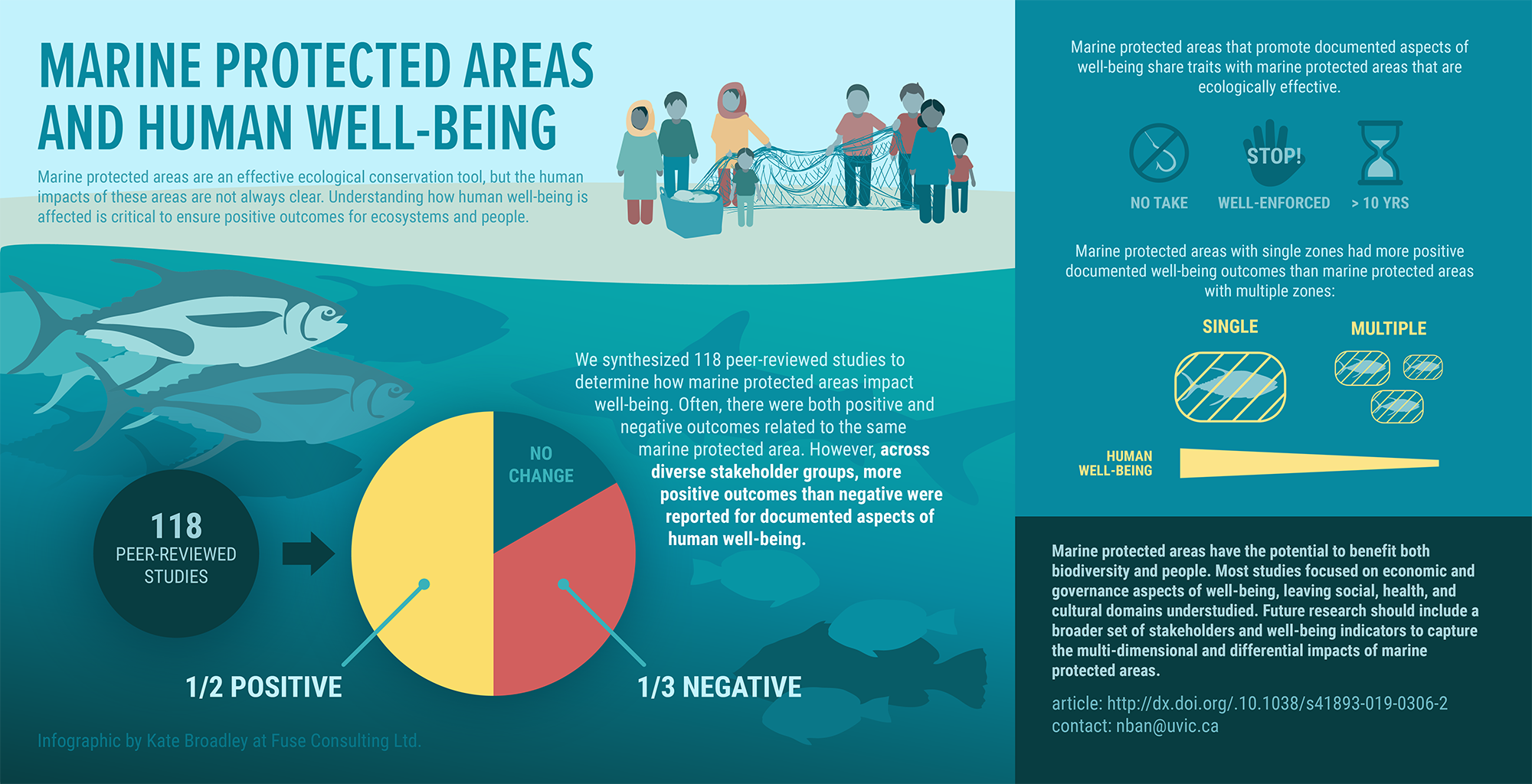
Graphic provided with permission from Dr. Natalie Ban, University of Victoria
“While we found more positive than negative human well-being outcomes of MPAs, it is interesting that commonly both can be found in the same MPA,“ said Dr. Natalie Ban, the study’s lead author and co-lead of the Pacific Working Group of the OceanCanada Partnership. She is an Associate Professor in the School of Environmental Studies at the University of Victoria and a UBC alumnus.
Whether MPAs led to positive or negative well-being outcomes was influenced by the direct effects of MPA governance processes or management actions, and by indirect effects from changes in the ecosystem. Direct effects included community involvement in management and conflicts arising during MPA planning processes, while indirect effects were generally due to recovering marine ecosystems like increased catch and income from resources.
“Studies that drill more into how to design MPAs that support both nature and people are crucial. This will help produce MPAs that are doubly beneficial,” said Dr. Rashid Sumaila, Director of the Fisheries Economics Research Unit, and a professor at UBC’s Institute for the Oceans and Fisheries and the School of Public Policy and Global Affairs. Sumaila is also the Director of the OceanCanada Partnership, which was a co-sponsor of the research.
The researchers found that studies mostly focused on how MPAs impact people’s economic well-being, such as their income or fishing catches, while giving much less attention to people’s social, health and cultural well-being. This can become an issue if these domains – which are harder to quantify and understudied, but are important for people’s acceptance of and compliance with MPAs – disappear from decision-making situations when not measured by researchers.
“We have an opportunity in Canada to design world-class networks of marine protected areas that not only conserve biodiversity but also account for the rights, needs and well-being of coastal communities,” said Bennett. “Using rigorous social science to understand and manage the social impacts of conservation can help to ensure that local people will support conservation.”
The study “Well-being outcomes of marine protected areas” was published in the journal Nature Sustainability.
Tags: biodiversity, faculty, FERU, IOF alumni, IOF Research Associates, Marine protected areas, Nathan Bennett, OceanCanada, Rashid Sumaila, Research

Dr. Sumaila and Dr. Auger-Méthé named as Canada Research Chairs
The Institute for the Oceans and Fisheries is pleased that today’s Government of Canada announcement of new Canada Research Chairs revealed that Dr. U. Rashid Sumaila has been named as Canada Research Chair in Interdisciplinary Ocean and Fisheries Economics (Tier 1), and Dr. Marie Auger-Méthé has been named Canada Research Chair in Statistical Ecology (Tier 2).
Sumaila named CRC Tier I in Interdisciplinary Ocean and Fisheries Economics, and Auger-Méthé named CRC Tier II in Statistical Ecology.

Dr. Rashid Sumaila
The Canada Research Chairs Program invests approximately $265 million per year to attract and retain a diverse cadre of world-class researchers, to reinforce academic research and training excellence in Canadian postsecondary institutions. The Canada Foundation for Innovation also made an important investment towards these Chairs. It is providing more than $5.2 million in new funding for research infrastructure, supporting 30 Chairs at 18 institutions, including 6 of the Canada Research Chairs at UBC.
Dr. Rashid Sumaila is a professor in the Institute for the Oceans and Fisheries. He specializes in bioeconomics, marine ecosystem valuation and the analysis of global issues such as fisheries subsidies, IUU (illegal, unreported and unregulated) fishing and the economics of high seas and deep seas fisheries. His pioneering research challenges the core tenets of traditional economics, prompting a rethink of the basic objectives of society with regards to oceans and fisheries. His ‘fish bank’ concept for the high seas provides a concept that has the potential to significantly advance ocean conservation on a global scale.
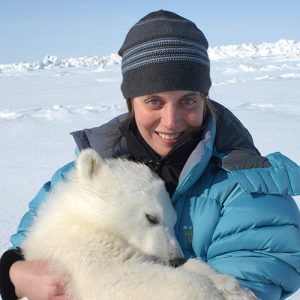
Dr. Marie Auger-Méthé
Dr. Marie Auger-Méthé is an assistant professor in the Institute for the Oceans and Fisheries and in the Department of Statistics. Most of her work is interdisciplinary in nature and at the intersection between ecology, statistics, and marine sciences. Her recent focus has been on developing and applying statistical models to understand the movement and space use of marine species.
Today’s announcement supports 15 new chairs at UBC, 16 renewed chairs and one Chair advancement. UBC has a current utilization of 205 Canada Research Chairs.
More information:
Tags: awards, faculty, FERU, Marie Auger-Methe, OceanCanada, Rashid Sumaila, SERG
Understanding the data about data: How metadatabases could improve Mexico’s ocean management
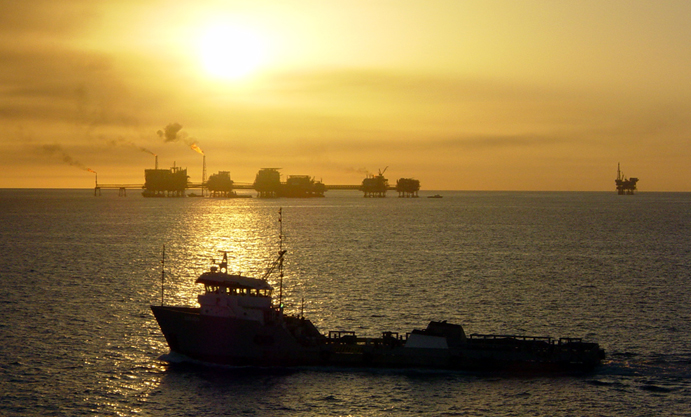
Photo Credit: “Gulf of Mexico” by Chad Teer via Flickr / CC BY 2.0.
Tucked between the Atlantic and Pacific Oceans, and bordered by the Caribbean Sea, Mexico is a country surrounded wide expanses of water. To counter the effects of climate change, understanding how Mexico can best manage its oceans is crucial.
Juliano Palacios-Abrantes
In a new study involving international institutions in Canada, Mexico and the United States, researchers compiled and analyzed information from existing databases to understand the current state of knowledge about ocean research in Mexico. Using this, they can help figure out how key decision-makers can take the best next steps against climate change.
“With this study, we aimed to collect the most amount of information available related to Mexico’s marine environment in order to not only understand what we know now, but also to provide a tool to improve the management and conservation of Mexico’s marine resources,” said Juliano Palacios-Abrantes, lead co-author of the study and PhD Candidate at UBC’s Institute for the Oceans and Fisheries (IOF) and UBC’s Department of Zoology.
Using Mexico as an case study, the study compiled and analyzed a massive amount of ocean knowledge into what is called a metadatabase, a database that catalogues information from other databases. While a large amount of data on marine ecosystems exists, it is often hard to find or access information about past or ongoing research, leaving individuals in certain fields unaware of related studies.
By compiling such data into an open-source metadatabase, however, the researchers could counter this issue and improve the current understanding of Mexico’s ocean research. They analyzed data from existing databases to understand the current knowledge trends and to identify gaps that could be addressed in future research, thus helping stakeholders and decision-makers make the best choices for ocean management and sustainability.
The researchers gathered data related to Mexico’s surrounding oceans from a variety of sources, including public websites, workshops, public data from governmental and environmental organizations, private data from industries, international sources and unpublished data kept by institutions.
“It can be hard for researchers to freely share data that could be private or sensitive, but by just focusing on understanding what exists, we can paint a better picture of where we are at in terms of scientific knowledge, what more information we need, and who is studying related issues so we can work better together,” said Andrés Cisneros-Montemayor, lead co-author of the study and a Program Manager and Research Associate with the Nippon Foundation – UBC Nereus Program. He is also part of the Fisheries Economics Research Unit at IOF (FERU).
“… just focusing on understanding what exists, we can paint a better picture of where we are at in terms of scientific knowledge, what more information we need, and who is studying related issues so we can work better together.”
Through their analysis, the researchers found that ocean-related research in Mexico has historically focused on mostly ecology and fisheries, with other topics like social issues, conservation or oceanography being represented less. The impacts of climate change on communities are now recognized as a major challenge for the future, which means there is a need for long-term ecological and social data to fill information gaps and help communities best adapt.
Andrés Cisneros-Montemayor.
Most information was available for the Gulf of California, Campeche Bank and Caribbean, and less for the central and south Pacific and the western Gulf of Mexico. “Anyone in Mexico knows that there are big regional gaps in our knowledge of the oceans, and you can see that in the metadatabase, which can help support research and researchers in those areas,” said Cisneros-Montemayor.
The researchers emphasized that in order to effectively manage human drivers of climate change, we need data that comes from different disciplines, spans the longest time range and covers different geographic scales. Creating metadatabases is one way to manage this problem by compiling such diverse data into one repository, especially for countries like Mexico which may have more limitations on data availability or research capacity.
“We have created here the most complete metadatabase of marine research in Mexico that allow us to have an idea of the data trends and gaps in the country,” said Palacios-Abrantes. “Thanks to the National Commission for the Knowledge and Use of Biodiversity (CONABIO) in Mexico, the final product is an open-source and dynamic tool that can be accessed by anyone and is open to the addition of new records. We hope that this multi-institutional effort helps improve marine conservation and management in Mexico.”
The study “A metadata approach to evaluate the state of ocean knowledge: Strengths, limitations, and application to Mexico” was published in the journal PLOS ONE.
The most updated version of the metadatabase of marine research in Mexico is generously hosted by CONABIO and can be found here: www.infoceanos.conabio.gob.mx.
Tags: Andrés Cisneros-Montemayor, FERU, IOF Research Associates, IOF students, Nereus Program, Research
Comprehensive global analysis shows a warmer ocean will hold fewer animals
The world’s oceans will likely lose about one-sixth of their fish and other marine life by the end of the century if climate change continues on its current path, a new international study says.
A group of 35 researchers from 12 countries and 4 continents presented a comprehensive global-ocean assessment of climate change by using a combination of multiple climate and ecosystem models. This model ‘ensemble’ reveals that global marine animal biomass – the total weight of marine animals such as fish, invertebrates and marine mammals in the ocean – will decline under all emission scenarios, driven largely by increasing temperature and decreasing primary production.
For every degree Celsius (1.8 degrees Fahrenheit) that the world’s oceans warm, the total mass of sea animals is projected to drop by 5%, according to the comprehensive computer-based study. And that does not include effects of fishing.
“We will see a large decrease in the biomass of the oceans,” if the world doesn’t slow climate change, said study co-author William Cheung, a marine ecologist at the University of British Columbia. “There are already changes that have been observed.”
For every degree Celsius (1.8 degrees Fahrenheit) that the world’s oceans warm, the total mass of sea animals is projected to drop by 5%.
The analysis also suggested that climate-change impacts may be more severe at higher food-web levels, meaning that fish and marine mammals may suffer more severe declines compared to phytoplankton. “The biggest animals in the oceans are going to be hit hardest,” said study co-author Derek Tittensor, a marine ecologist at the United Nations World Conservation Monitoring Center in England.
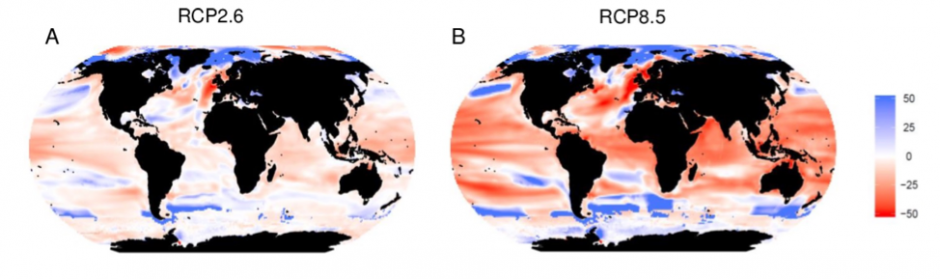
Projected changes of marine animal biomass by the end of the 21st century (% increase or % decrease compared to the end of the 20th century) under two IPCC emission scenarios: RCP2.6 assumes strong mitigation, RCP8.5 assumes business-as-usual emissions. ©2019 by National Academy of Sciences
“The good news here is that the main building blocks of marine life, plankton and bacteria may decline less heavily, the bad news is that those marine animals that we use directly, and care about most deeply, are predicted to suffer the most as climate change is working its way up the food chain,” co-author Boris Worm, a marine biologist at Dalhousie University in Canada, said in an email.
Tropical areas, already warm, will also see the biggest losses, Cheung said.
Scientists had already thought that climate change will likely reduce future ocean life, but past computer simulations looked at only part of the picture or used only one model. This study uses six different state-of-the-art computer models that give the best big picture look yet, Cheung said.
It is hard to separate past climate change impacts from those of fishing, but past studies have shown places where observed fish loss can be attributed to human-caused climate change, Cheung added.
The study, “Global ensemble projections reveal trophic amplification of ocean biomass declines with climate change” was published today in the Proceedings of the National Academy of Sciences (PNAS)
Tags: climate change, CORU, faculty, William Cheung

Carl Walters appointed to the Order of British Columbia

Dr. Carl Walters, professor emeritus
The Institute for the Oceans and Fisheries is beyond thrilled to congratulate Dr. Carl Walters, professor emeritus, who has been appointed to the Order of British Columbia.
An icon of the world’s fisheries science community, Dr. Walters has conducted research and developed computer models that have had an important impact on fisheries science for the last 50 years.
The Order of British Columbia investiture ceremony will be held for recipients and invited guests at Government House in Victoria on June 28, 2019.
More information: Official news release – Order of British Columbia honourees
Tags: awards, Carl Walters, faculty