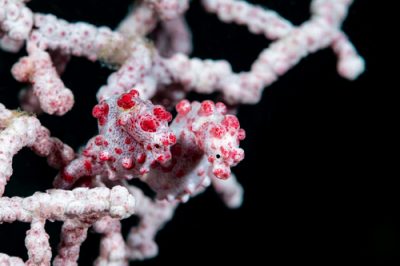
Pygmy Seahorse (Hippocampus bargibanti) © Francois Libert, some rights reserved (CC BY-NC)
Researchers from Project Seahorse – a marine conservation team based at the University of British Columbia (UBC) and the Zoological Society of London (ZSL) – identified and reviewed new findings related to 35 of the 46 seahorse species found around the globe, all of them posted by citizen scientists using the team’s iSeahorse program, part of the iNaturalist family.
The iSeahorse program allows community, or citizen, scientists – members of the public and non-professional or amateur researchers – to provide information about their sightings of seahorses in the wild. Posting on the website, they provide information about which species of seahorse, when and where in the world they saw it, its habitat, and its depth. They are also asked to provide photographic evidence if they are able.
Undertaking an analysis of 7,794 validated iSeahorse observations from 96 countries and across 35 seahorse species, posted from October 2013 to April 2022, researchers were impressed by the information they gained and its effect on knowledge about seahorses.
“The new findings will enhance global conservation assessments of the species in the world’s definitive IUCN Red List of Threatened Species,” said Elsa Camins Martinez, then a MSc student at UBC’s Institute for the Oceans and Fisheries and first author on the paper.
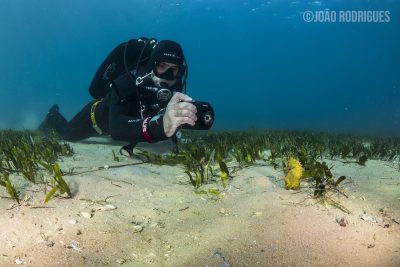
Diver logging encounter with seahorse. ©João Rodrigues
“Comparing habitat types reported in iSeahorse with those in the IUCN Red List assessment for each species, we found new habitats for 80 per cent of species,” said Dr. Amanda Vincent, UBC professor, co-founder and Director of Project Seahorse, as well as senior author on the research. “We found new habitats for Hippocampus comes, Hippocampus histrix, H. kuda, Hippocampus kelloggi, and Hippocampus spinossisimus, each with five to six new habitats.”
“It was fascinating that the iSeahorse data extended the known breeding season for five species,” added Camins. “In the tropics, seahorses were reported as breeding in every month. Surprisingly, this was also true in the Northern Hemisphere Asian species, although with more breeding in the spring.”
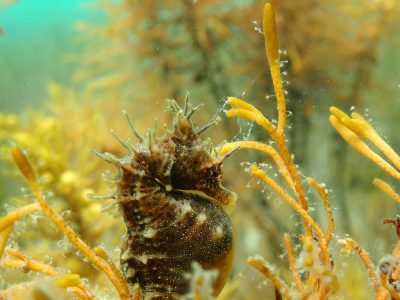
Shorthead Seahorse (Hippocampus breviceps) Observation © Josie Jones · some rights reserved
“With the assistance of our community contributors, we were able to gather information on a much broader scale,” says Heather Koldewey, co-founder of Project Seahorse, ZSL’s Senior Marine Technical Advisor, and co-author on the paper. “This study has demonstrated the value of community science in advancing seahorse knowledge, by helping bridge gaps. Seahorses are very much the sort of fascinating species that benefit from community science, as they are cryptic enough to make even formal research challenging. The results from all these efforts show the importance of promoting marine community science and the important role it can play in conservation, by generating knowledge and mobilizing engagement and action.”
Project Seahorse
Project Seahorse is a leader in marine conservation, making discoveries & and collaborating globally to take effective action for seahorses and their seas. The organization cares for seahorses as flagship animals, conducting cutting-edge research on protected areas, fisheries and wildlife trade… , and applying the new knowledge to produce highly effective conservation interventions. Project Seahorse has won many international awards and honours, and works with researchers, governments, conservation groups and local communities worldwide. Project Seahorse is based at the University of British Columbia, Canada, and Zoological Society of London, UK. Visit www.projectseahorse.org for more information.
ZSL
Founded in 1826, ZSL is an international conservation charity, driven by science, working to restore wildlife in the UK and around the world; by protecting critical species, restoring ecosystems, helping people and wildlife live together and inspiring support for nature. Through our leading conservation zoos, London and Whipsnade, we bring people closer to nature and use our expertise to protect wildlife today, while inspiring a lifelong love of animals in the conservationists of tomorrow. Visit www.zsl.org for more information.
Tags: Amanda Vincent, citizen science, conservation, faculty, IOF students, iSeahorse, IUCN, Project Seahorse, Research, seahorses
 Congratulations to MSc student Aleah Wong, who has made it to the final round of the Social Sciences and Humanities Research Council (SSHRC)
  Dr. William Cheung, professor and Director of Institute for the Oceans and Fisheries, who was appointed as a Canada Research Chair in Ocean Sustainability and Global Change (Tier II) in 2018 was renewed for another five years. His appointment will now be ending in 2028.
 Dr.
Dr. 
 Back at UBC in 1995, my colleagues would see a black person from afar and they would automatically assume that it was me. There were just so few of us on campus. It wasn’t expected that a black man would be in STEM. However, now, things are slowly starting to get better, and there’s more Black people here, more openness.
 I remember, when we came here, finding a place to rent — it was so hard, you wouldn’t believe it. I would see an ad in the paper and call. They’d say come on over, come over and check it out! When I got there, they’d open the door, see me and say, oh we’re sorry, the room is taken. It was unbelievable. But, at the end of the day, we made friends with this lady, Catherine. She had a bed and breakfast, and I called her to find out if she could rent a room for us, and she said come on in. I went and she was leaving for an appointment, and simply said, here’s the key, check out the place and feel at home. She was amazing.