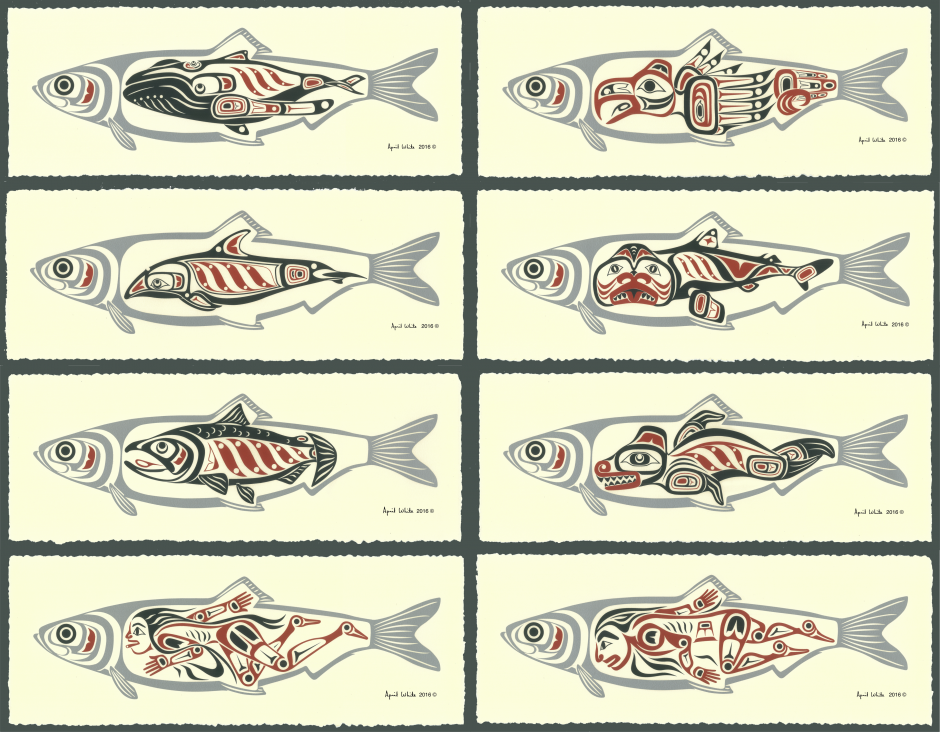
On Sunday, April 2, 2017, IOF presented this public event, which aimed to raise awareness of Pacific herring’s role in BC marine ecosystems, aboriginal communities, and commercial fisheries.
Held in the iconic Bill Reid Gallery, Herring People included a welcome greeting from Hereditary Chief and master carver James Hart, who spoke about reconciliation in the context of the Reconciliation Pole, raised at UBC ON April 1, 2017. Haida artist April White officially launched her “Herring People” serigraph series, and Dr. Mimi E Lam, presented “What values are at stake in the management of herring in BC?”
New research supports the creation of more marine reserves in the world’s oceans because, the authors say, fish can evolve to be more cautious and stay away from fishing nets.
The research suggests that by creating additional “no-take” areas, some fish will stay within marine reserves where they are protected from fishing. While other fish will move around the ocean, these less mobile fish will continue to live in the protected areas, pass this behaviour on to their offspring, and contribute to future generations to increase the overall stock.
“Even for fish like tuna and sharks that spend a lot of time far from shore, marine reserves are an important conservation tool,” said Jonathan Mee, lead author of the study, and a faculty member at Mount Royal University, who conducted this research while completing a postdoctoral fellowship at UBC. “We used mathematical modelling to find out under what conditions marine reserves might push fish to evolve to escape capture.”
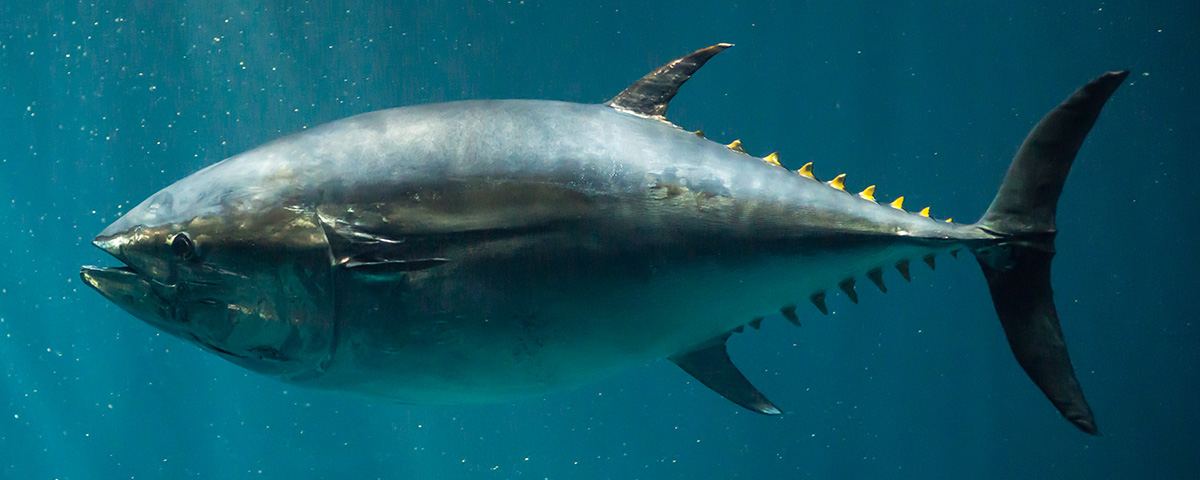
In a collaboration between UBC’s Biodiversity Research Centre and the Sea Around Us project at the Institute for the Oceans and Fisheries, researchers modeled the movements of skipjack and bluefin tuna and great white sharks in the ocean.
They found evidence that within 10 years of creating new marine reserves, the movement pattern of tuna could change while it would take up to five decades for the longer-living great white shark to change. They also found evidence that the greater the fishing pressure close to the reserves, the faster the fish would evolve to stay in the protected space.
The researchers argue there is a need to create more marine reserves because fishing operations have grown exponentially in recent decades, leading to a global catch decline of 1.2 million tonnes of fish per year.
“The boats got bigger and now we can cover the entire range of the tuna. The distance doesn’t protect them, depth doesn’t protect them, nothing protects them except our decision to remove ourselves from certain areas in the form of marine reserves,” said Daniel Pauly, principal investigator of the Sea Around Us project and a co-author of the study. “A well-controlled marine reserve would, at least in part, protect against the effect of overfishing outside the reserve.”
These findings show fisheries managers, conservation planners, environmentalists, and professionals in the fishing industry the effectiveness of marine reserves.
“The reserves are likely more effective than previously thought in preventing extinction for some species, protecting biodiversity and even acting as an insurance policy,” said Sarah Otto of UBC’s Biodiversity Research Centre.
For MSc candidate Madeline Cashion, sharks have always been a part of her life. “When I was very young my mother would make me write poems and I wrote them about sharks. I think I was fascinated by how powerful they are. Somewhere at home I have a book of those poems, shark facts that I collected, and collages I made as a child.” That would not be surprising for a child growing up near the ocean, but as Madeline puts it, “growing up in land-locked Calgary, it was a bit odd.”
With her interest firmly fixed on the oceans, Madeline began her academic career with an undergraduate degree at Dalhousie University, before coming to the University of British Columbia to work with renowned marine scientist, Dr. Daniel Pauly, and the Sea Around Us project.
She studies shark fishing; primarily how many are fished, what species are caught, what fishing gear type is used to catch them, and what does this mean for shark populations. “They are fished widely internationally, but not much is known about the catch. We need to know because about a quarter of the class of fish that includes sharks are threatened with extinction. They are very important for marine ecosystems, so we need to be sure we understand what is happening with their exploitation.”
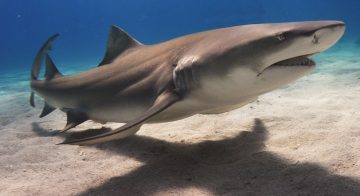
Lemon Shark. Photo: Albert Kok/Flickr
Madeline is developing a method to discern which species of sharks are caught, which she hopes will eventually be used globally. For now, she is testing her methods in the Mediterranean and Black Seas. “This area is contained,” she says. “There are no international waters, just waters that are split into countries that border them, so it is easier to develop the method.” And there are lots of shark species to study. “In the Mediterranean there are big oceanic pelagic species, such as shortfin mako sharks, porbeagle sharks, (which are critically endangered), blue sharks. There are also little sharks that live on the bottom, like catsharks and nurse sharks, these are highly impacted by trawlers which scrape the bottom of the sea. Sharks have been fished in those seas for a long time, sometimes targeted specifically, but also caught as bycatch, which means fishers are not trying to catch them but do anyway. Sharks don’t do well when they have been sitting in a fishing net, or hooked, for many hours and then released. They often die, depending on the species. So it is really important to find out where the bycatch is happening and to which species.”
She acknowledges that as a top predator sharks are feared, but points out that in a given year only a handful of people may die from shark attacks, while in the same period, humans kill approximately 63-273 million sharks (2013 figures). “Which is worrying because they are an integral part of the marine ecosystem. As a top predator, if they are caught then you are reducing the control on the species below. For ecosystems, such as coral reefs, this means that reef health is affected. They become less and less resilient, unable to adapt to climate change, or deal with invasive species, (such as lionfish in the Caribbean).”
Madeline enjoys her research on sharks, and hopes that more women become involved in the sciences. “UN figures say that only about 20% of researchers in science are women. That is very small; too small. We need to encourage them to stay focused on the sciences at a young age.” She points to her experience volunteering at the Vancouver Aquarium. “When I am at the Aquarium we teach kids about marine biology and conservation. The curriculum program we have there is science-focused, but also very accessible. And at young ages you don’t see any differences. They all soak it up. Girls are just as interested as boys. We need to encourage any interest a child has,” she concludes.
Madeline is happy to share one of the shark facts that fascinated her as a child. “Sharks are older than trees,” she says with excitement. “Sharks have been on this Earth longer than trees have. They’ve had so much time to evolve, and it is why there are such crazy forms of sharks; some eat plankton like the basking shark, and some are top predators like tiger sharks and white sharks.
“I think it is that diversity, and how key they are for the ecosystems, that drives me to study them.”
Madeline discusses her research as part of the UBC’s 3 Minute Thesis competition
The BBVA Foundation Frontiers of Knowledge Awards seek to recognize and encourage world-class research and artistic creation, prizing contributions of lasting impact for their originality, theoretical significance and ability to push back the frontiers of the known world.
These international awards span eight categories: Basic Sciences (Physics, Chemistry, Mathematics), Biomedicine, Ecology and Conservation Biology, Information and Communication Technologies, Economics, Finance and Management, Contemporary Music, Climate Change and Development Cooperation.
The Prix d’Excellence recognizes the highest level of achievement in marine sciences and important contributions to ICES vision.
Like the community ICES envisions, this award is broader than ICES. Contributions within the ICES region and throughout the world are recognized. Candidates for this award need not have had an association with ICES, although their work and achievements will be relevant. They will have contributed to the sustained use and conservation of marine ecosystems through their research, scientific leadership and/or leadership in the objective application of science to policy. Innovation, teamwork, mentoring, and objective communication with the public exemplify the career of the recipient of this award.
The Prix d’Excellence is presented every third year at the ICES Annual Science Conference (ASC). Travel expenses to the ASC to receive the award will be paid from revenue from the conference registration fee, and the recipient’s registration fee will be waived in the future.
Nomination package:
Initially, nominations simply require a name and a few sentences about the nominee. The Awards Committee may then request additional supporting materials to assist the decision-making process.
The AAAS Award for Public Engagement with Science, formerly “AAAS Award for Public Understanding of Science and Technology” established in 1987, recognizes scientists and engineers who make outstanding contributions to the “popularization of science.”
The recipient receives a monetary prize of $US5,000, a commemorative plaque, complimentary registration, and reimbursement for reasonable travel and hotel expenses to attend the AAAS Annual Meeting to receive the prize.
Eligibility
Eligible nominees include active or retired scientists and engineers from all disciplines, who have contributed substantially to the public’s engagement with science or technology.
Materials to be considered include websites, books, magazines, and newspaper articles; video, film, and broadcasting; lecturing; museum presentation and exhibit design; and other public outreach activities, local, national, and/or international.
Only materials produced for general audiences, as opposed to professional or trade audiences, will be considered.
Employees of the AAAS are not eligible.
Nominees considered “early career,” which is defined as an individual who has been in thier current field for less than seven years and pre-tenure or job equivalent, including post-doctoral fellows (meaning the nominee is typically within 7 years of receiving a PhD) may be eligible for the AAAS Early Career Award for Public Engagement with Science.
Requirements
for the nominee: name, position, institution, e-mail, phone, and professional and home addresses;
for the nominator: name, position, institution, e-mail, phone, and professional and home addresses;
a statement of the public engagement activities that form the basis for the nomination (PDF, 500 word limit);
at least two representative material samples or other documentation which illustrate or describe the nominee’s contribution (PDF);
the nominee’s CV (PDF);
and the names and e-mail addresses of two supporting persons whom AAAS may contact for more information on the nominee and their contributions.
Note:
Nominations must be made in English.
Re-nominations MUST include a cover letter (PDF) recapitulating the application material, listing additional work since last submission, and explaining why the nominee deserves to be reconsidered.
All physical material (books, CDs etc) submitted becomes the property of AAAS.
The President’s Fishery Conservation Award, is presented in two categories:
(1) an AFS individual or unit, or
(2) a non-AFS individual or entity, for singular accomplishments or long-term contributions that advance aquatic resource conservation at a regional or local level.
Nomination package:
A strong and detailed letter describing the nominee’s contribution and the evidence for accomplishment at a regional or local level
Nominations may be supported by multiple individuals by signing one letter, or by submitting supporting letters in addition to the main nomination letter.
If the nomination is for an individual, CV of nominee
Nominee’s title and full contact information (address, email, and phone)
To an individual or organization for a singular accomplishment or long-term contributions that advance aquatic resource conservation at a national or international level.
Nomination package:
A detailed letter of nomination to address award criteria, and the evidence for being “significant at a national or international level”
Nominations may be supported by multiple individuals by signing one letter, or by submitting supporting letters in addition to the main nomination letter.
If the nomination is for an individual, CV of nominee
Nominee’s title and full contact information (address, email, and phone)
The BBVA Foundation Frontiers of Knowledge Awards recognize fundamental contributions in a broad array of areas of scientific knowledge, technology, and humanities and artistic creation.
The disciplines and domains of the BBVA Foundation Frontiers of Knowledge Awards are:
Basic Sciences (Physics, Chemistry, Mathematics)
Biology and Biomedicine
Information and Communication Technologies
Ecology and Conservation Biology
Climate Change
Economics, Finance and Management
Humanities and Social Sciences
Music and Opera
The Climate Change award recognizes both research endeavours in confronting this challenge and impactful actions informed by the best science. In Humanities and Social Sciences, the award will alternate annually between these two disciplinary domains, with this eleventh edition dedicated to the Humanities. Finally, the Music and Opera category encompasses composition, instrumental and vocal performance, musical and stage direction, and video art creation associated with musical or operatic works.
Requirements
Award category for which the candidate is nominated
Name of the nominating institution and officer/body, with the corresponding contact data (postal and e-mail address, plus landline and cell phone numbers)
Letter of nomination signed by the nominating officer/body
Candidate particulars including institutional affiliation and contact data
Description of the salient contributions of the candidate and reasoned arguments for the nomination (maximum of three pages, single spaced)