There is truth in the saying “you are what you eat”; even more so if you are a salmon or herring swimming off the British Columbia coast, a recent UBC study discovered.
Juvenile salmon and herring will feed on any organisms in the ocean that are in a suitable size range; generally something the size of a marble or smaller. In other words, zooplankton. While researchers know that the amount of, and availability of, zooplankton prey is important to the young fish, little was known about the importance of its nutritional quality.
A new study by scientists at the University of British Columbia, together with scientists from Fisheries and Oceans Canada, measured the biochemical properties of zooplankton in the Strait of Georgia, including essential fatty acids, specifically to answer questions around nutritional value of different zooplankton species, and its spatial and seasonal variability in British Columbia.
“We showed that seasonal changes in plankton food web pathways drive variability in plankton fatty acid composition,” said Dr. David Costalago, lead author of the study, and, at the time of the study, a MITACS-Pacific Salmon Foundation postdoctoral fellow with the Pelagic Ecosystems Lab at UBC’s Institute for the Oceans and Fisheries. “This seasonal shift conferred a higher nutritional value to zooplankton in the summer, indicating better quality prey for juvenile salmon and herring during this period. Essentially, juvenile salmon and herring out-migrating from the rivers into the Strait of Georgia late in the season may encounter better food than the bulk of migrants coming out to the ocean in the earlier May-June period.”
In addition to seasonal and spatial differences in zooplankton prey quality, this study found that there are huge differences in nutritional value among zooplankton species. From a juvenile salmon perspective, not all zooplankton are equal.
“Differences in the quality of zooplankton as prey are really important for juvenile salmon. They depend on nutritious food for healthy development,” said Dr. Brian Hunt, UBC Hakai Professor in Oceanography at the Institute for the Oceans and Fisheries. “The differences we found in the fatty acid composition of zooplankton species in this study tell us that climate driven changes in the composition of zooplankton communities may be an important factor in salmon declines.”
The growth and survival of fish are conditioned by the nutritional quality of their food, and the fish that grow quickly during early life stages are more likely to reproduce. This study identified a need for better monitoring of nutrition in the ocean, and further research to understand the nutritional pathways that connect the base of the food-web to the rest of the ecosystem.
“By determining the availability of high-quality prey for these commercially important groups of fish we can improve estimates of herring and salmon productivity and help inform fisheries management of these species in the region,” said Costalago. “Routine surveying of the plankton throughout the Strait of Georgia, using the tools our study described, may be useful in assessing ecosystem health and guiding management of economically and ecologically important marine populations.”
The Institute for Oceans and Fisheries is proud to stand in solidarity with UBC’s Black Student Union and all people protesting police violence against Black people in Canada and the United States.
Systemic anti-Black racism is not limited to the United States, but also thrives in a Canadian context. Racism is a global issue and one that impacts all of our communities, including here in the IOF and at UBC as a whole. Black people in academia face many barriers that we as a community must actively confront, including lacking a sense of belonging, limited access to outdoor experiential education or field research, and microaggressions on campus.
We join UBC President Santa Ono in denouncing and condemning anti-Black racism, as well as all other forms of racism, including the ongoing oppression of Indigenous peoples, and the anti-Asian racism that has surged as a result of the COVID epidemic.
The IOF is committed to continuing the work we have begun to foster diversity, equity, inclusion, and wellness within and beyond our community. We commit to confronting racism in our classrooms, our hiring practices, our faculty meetings, our labs, our fieldwork, and in the communities in which we live and work.
We look forward to having each of you join us in this journey. If you are interested in helping to shape the directions we take moving forward as a department, please consider joining the IOF Equity, Inclusion and Wellness Committee by emailing Neil MacLean. Graduate students can join the IOF Student Society’s Equity, Diversity and Inclusion Subcommittee by emailing Ron Togunov.
Sincerely,
Evgeny Pakhomov
Professor and Director, Institute for Oceans and Fisheries
With the ongoing climate of egregious acts against the Black community all over the United States and Canada, we would like to state that we stand firm, united, and with those indirectly and directly impacted by the recent violence against our communities.
We stand in solidarity with the families and friends of Regis Korchinski-Paquet, Ahmaud Arbery, George Floyd, and many more who were violently murdered by the police.
Despite these acts being clear attempts at further oppressing our community, as history has shown time and time again, the Black community will remain defiant, strong, resilient, ever-growing, and omnipotent. As a community, we will continue to fight until our plights are seen and our people have obtained the justice they deserve.
At this time, we ask you to take action by using your voices and platforms to raise awareness and consciousness on the systems put in place that do not act for us all. We ask that you continue to donate to key organizations that are helping people in our communities during this difficult time. And finally, we also ask that you continue to sign petitions that demand justice.
To our fellow brothers and sisters, remember to take care of yourselves and reach out to those around you. It is okay to disconnect and take some time to breathe. We are all grieving at this time. We are here for you as your community leaders and as your family. We, as a team, will continue to work for us all.
Many condolences and much more love,
The University of British Columbia’s Black Student Union
As COVID-19 affects global food systems, tremendous impacts are being felt by coastal communities and small-scale fishers, many of whom are self-employed and rely on the catch to feed their own households or local communities.
In a review published in Coastal Management, researchers explore the impacts of the COVID-19 crisis on small-scale fisheries in Canada and worldwide, and provide recommendations on how to support them.
Nathan Bennett
We spoke with lead author Nathan Bennett, research associate with the Institute for the Oceans and Fisheries at UBC, and Chair of the People and the Ocean Specialist Group for the International Union for the Conservation of Nature (IUCN), about the findings.
COVID-19 has negatively impacted economies across the globe. Why is your focus on small-scale fisheries so important?
NB: Globally, there are approximately 32 million people directly employed in small-scale fisheries with an additional 76 million who process and market this catch. Most of the catch from these fisheries – up to 81 per cent according to World Bank figures from 2012 – is used for local human consumption. Especially in the developing world, coastal communities are highly dependent on fish for protein. Yet there is a tendency to underplay the importance of small-scale fisheries for livelihoods and their contribution to food security and they are often ignored by governments. We are worried that they are also being highly impacted and not getting the assistance they need during the COVID-19 crisis.
In what ways has the small-scale fishing industry been affected?
NB: Our team of international researchers were, unfortunately, unable to go into the coastal communities to evaluate how the COVID-19 pandemic is impacting the small-scale fisheries sector because of mobility restrictions. We turned, instead, to media accounts and other public sources of information. Much of the news was bleak. In Canada, for example, we heard that demand was way down for lobster, crab, halibut and many other fish. Indigenous fisheries, such as the Heiltsuk herring roe-on-kelp fishery, have also collapsed. Prices have fallen so low that many fishers cannot afford to leave the dock or were selling at a loss. Many fishers are staying home, even at a time when many Canadians are in need of food. Many who work in processing plants are out of work. The economic impacts are being felt in coastal communities across Canada.
Worldwide, the impacts have also been mostly negative for small-scale fisheries. At the beginning of the COVID-19 pandemic many fisheries faced complete shutdowns as they were not considered vital to national food supply systems. Ports, markets and processing facilities were also closed due to the close quarters and risks of spreading COVID-19. Export-oriented small-scale fishers faced a vast reduction in demand and slashed prices. Even in fisheries that remained open, people had to make difficult decisions about feeding their families or risking exposure. Some groups, such as migrant workers and women – who comprise 80 to 90 per cent of the post-harvest sector – are bearing the brunt of the pandemic.
We also found some positive outcomes, such as fishers going out and then sharing food in their local communities. There has also been an increased demand for fish from community supported fisheries such as Skipper Otto in Vancouver. Home delivery systems and online fish sales platforms have boomed as far away as South Africa, Mexico, and Ghana. Across North America, the Local Catch Network has created a public registry of community supported fisheries and local harvesters from whom locals can buy seafood directly. More broadly, small-scale fishers are working to safeguard their livelihoods and access to food. Many civil society organizations are working with local and regional governments to mitigate impacts of the closures and to develop guidelines for safe and equitable re-opening of small-scale fisheries.
When this pandemic is over can we go back to business as usual for small-scale fisheries? Will things need to change?
NB: While the crisis is still unfolding, there is an urgent need to mobilize support for small-scale fishers and coastal fishing communities. A collective response is needed to meet the scale of the negative impacts that are being experienced by the small-scale fisheries sector. The voices of local fisheries and communities must be engaged when designing responses to this situation. Specific support is needed for vulnerable and often neglected groups, such as migrant workers and women.
Yet, there is also a danger that some organizations will promote oversimplified solutions based on pre-existing agendas or worldviews that do not align with local contexts. Responses to the COVID-19 pandemic must not undermine Indigenous and local people’s rights to harvest, consume and sell fish from their waters.
We must act now to help mitigate the worst impacts of COIVD-19 on small-scale fishers. Governments, development organizations, NGOs, donors, the private sector, and researchers all have a role. In the long run, support will be needed to help rebuild the capacity and resilience of small-scale fisheries and coastal fishing communities.
Amanda Vincent becomes first marine conservationist to win Indianapolis Prize
University of British Columbia marine biologist Amanda Vincent has won the 2020 Indianapolis Prize, the world’s foremost award for animal conservation, for her trailblazing work to protect seahorses and other marine life.
The influential prize recognizes conservationists who have made significant progress in saving a species, or multiple species, from extinction. Vincent, who was the first biologist to study seahorses in the wild, has dedicated her career to investigating their ecology, uncovering their extensive global trade and establishing projects for their conservation around the world.
Amanda Vincent underwater with two seahorses. Credit: Amanda Vincent – Project Seahorse
“I’m absolutely thrilled. The Indianapolis Prize is as close as one gets to a Nobel Prize in animal conservation,” said Vincent, a professor at the Institute for the Oceans and Fisheries at UBC, where she directs Project Seahorse. “I started off wanting to save seahorses but we quickly realized that many of the biggest threats to seahorses – from illegal wildlife trade to annihilation fishing practices like bottom trawling – are the same threats faced by many other ocean species and habitats. If we could convince people to protect seahorses, maybe we could save the ocean too.”
Vincent’s work has not only brought attention to seahorses but has also helped develop effective approaches to conservation that have improved the status of many other marine fishes, such as sharks and rays, and protected vast swathes of coastal habitat across the world.
“Amanda Vincent’s determination to protect the ocean and the species that inhabit it is nothing short of heroic,” said Rob Shumaker, president and CEO of the Indianapolis Zoological Society Inc., which presents the award every other year. “Vincent brings a collaborative, culturally sensitive and solutions-focused approach to ocean conservation that inspires and drives positive outcomes for marine species. It’s our privilege to recognize and reward her for her immeasurable impact on ocean conservation and future of seahorses around the world.”
A Trojan seahorse to save the seas
Vincent’s pioneering approach to their conservation rests on three pillars: a deep knowledge of the animals, promotion of the fish as essential to the world’s biodiversity and collaborative, sustainable management approaches that also benefit humans.
Vincent is the foremost expert on their biology, having studied them in 38 countries and co-authored a definitive taxonomy that helps distinguish between the 44 look-alike species.
“My interest in them began as a way to study the evolution of sex differences because only male seahorses get pregnant and give birth,” said Vincent, who discovered that some species form monogamous pair bonds.
Traditional medicine display. Credit: Project Seahorse
But it was a chance sighting of a billboard in Germany advertising seahorses from the Philippines as a good for “men with weak tails” that marked a profound shift from scholarship to action in the early 90s.
“I spent the next few years doing detective work through Asia and eventually managed to map out this massive hidden trade in seahorses spanning about 80 countries,” said Vincent. “The scale of the trade was astounding, with millions of seahorses being sold for use in things like traditional medicines, aquarium displays and souvenirs.”
Vincent realized that in order to protect them, she needed to get them recognized as something other than simply a resource for exploitation – both at global and local scales.
Vincent also partnered with local communities and biologists, industry groups, aquariums and governments around the world to develop sustainable approaches to seahorse trade, rather than work to ban all trade outright.
The approach allowed her to motivate Australia to regulate the extraction of seahorses and similar fishes, and prompted the Hong Kong Chinese Medicine Merchants Association to implement a voluntary code of conduct for seahorse imports.>
In the Philippines, she initiated an alliance of 1000 small-scale fishing families to co-manage seahorses and helped create 35 marine protected areas – dedicated areas of the ocean where no fishing is allowed and the populations of seahorses and other marine fishes thrive.
Amanda Vincent and fishers in Balicasag, Philippines. Credit: Amanda Vincent – Project Seahorse
“It turned out that we wanted the same thing as the local fishers – for there to be enough seahorses that you can fish off a few without losing entire populations,” said Vincent.
Then, in 2002, she played an instrumental role in persuading the United Nations Convention on International Trade in Endangered Species (CITES) to adopt milestone legislation to limit global seahorse trade to sustainable and legal exports, with seahorses becoming the first marine fishes to be included since the inception of the Convention in 1976.
Together, these efforts furthered the legitimacy of marine conservation and created policies to effectively and sustainably manage fisheries all over the world. As of 2018, countries that previously exported 96 per cent of dried seahorses had suspended trade.
“People didn’t see fish as wildlife, but Amanda changed that,” said Sarah Foster, a long-time collaborator and project manager at Project Seahorse.
The power of a few to protect many
Vincent’s greatest contribution to marine conservation may be the people she has inspired along the way, from school children to businesses like Guylian Chocolates Belgium, which has funded Vincent’s research and conservation activities for more than 20 years.
Long-snouted-seahorse in Croatia. Credit: Claudia-Gravenstein – Guylian
Since 1996, Vincent and Project Seahorse – which was established in partnership with the London Zoological Society, have trained more than 175 professional conservationists and inspired countless amateur conservation advocates to contribute through a citizen science program call iSeahorse.
She and her Project Seahorse team are now focused on bringing an end to the harmful fishing practice that is the single biggest threat to seahorses – bottom trawling – where industrial nets are dragged across the ocean floor, catching all life in their path and destroying vital habitats such as coral reefs, mangroves and seagrass beds. Project Seahorse estimates that more than 70 million seahorses are ripped from the ocean by trawls and other nonselective fishing gear every year.
“This waste of life has to stop – we’re allowing devastation of our oceans in a way that we would never permit on land,” said Vincent. “Through the perspective of seahorses, we have inspired many, many people globally to safeguard ocean life. The Indianapolis Prize now gives us an even bigger platform to invite and empower people to take meaningful conservation action.”
India has an extensive coastline and its waters are home to six seahorse species, and has been very active in catching and exporting seahorses. In 2001, it was also the first country to implement a national ban on exploitation of seahorses, prior even to seahorses being listed under CITES. In the two decades since the ban, however, it has become clear that catch and trade bans, as they stand, may have limited capacity to protect the species as they are primarily caught as bycatch. To understand the current situation fully, we need to understand the status of seahorse catch and trade before India’s ban and before CITES’ global action.
This Fisheries Centre Research Report (FCRR) documents the first seahorse trade surveys and analyses conducted by Project Seahorse in India, in 1999. These were the last comprehensive surveys about India’s seahorse species, distribution, fisheries, and trade, before the imposition of its national ban on seahorse catch and trade and provides a baseline for comparisons to help understand the impact of that ban for seahorse conservation. Making these 1999 data public will help policymakers evaluate the use of a ban as a management tool for seahorses and contribute to helping the improved management of seahorses in India.
A large marine heatwave would double the rate of the climate change impacts on fisheries species in the northeast Pacific by 2050, says a recently released study by researchers from the University of British Columbia and University of Bern.
In 2013, a large marine heatwave, nicknamed the ‘Blob’, occurred in the northeast Pacific Ocean. From the coast of Alaska to Baja California, the Blob had a significant impact on the marine life and fisheries in this region; an impact that lasted for several years.
The new study, released in the journal Scientific Reports, combined the latest climate, ocean and fish modelling approaches to quantify the future impacts of marine heatwaves like the Blob on fish stocks along the west coast of Canada and USA. The resulting models showed that future ‘blobs’ would exacerbate climate change impacts on these important fish stocks, causing them to decrease in biomass and generating shifts in their distribution, which, in turn, would impact the fisheries sectors in this region.
“Previous studies have largely under-estimated climate change impacts on our marine life as they focused on changes in the average conditions,” said William Cheung, professor and Canada Research Chair in Ocean Sustainability under Global Change at the UBC Institute for the Oceans and Fisheries. “The actual impacts in the next few decades are likely to be doubled when marine heatwaves occur. For example, in the year when a marine heatwave occurs, the average biomass of sockeye salmon in the ocean off Alaska and British Columbia is projected to reduce by more than 10 percent. This is in addition to a biomass decrease of 10-20 percent that is expected under long-term climate change.”
“Marine heatwaves similar to the Blob are going to occur more frequently and with higher intensity in the coming decades,” said Thomas Frölicher, assistant professor at the Physics Institute and Oeschger Centre for Climate Change Research of the University of Bern. “Our results underscore the need for a reduction of anthropogenic greenhouse gas emissions – the fundamental driver of ocean warming, to limit challenges from marine heatwaves on fish stocks and fisheries.”
“The COVID-19 pandemic has made us very much aware of the need to be prepared for impactful episodic events such as marine heatwaves,” said Cheung. “The Blob will return, and with climate change still taking place in the background, its impact will be even greater. Early prevention is the key – in this case that means active climate mitigation and effective adaptation.”
The paper “Marine heatwaves exacerbate climate change impacts for fisheries in the northeast Pacific” was published in Scientific Reports.
What did the Burrard Inlet look like in the past, compared to how it is now? What were the fishing, food source, and maritime resources there and how did this habitat change over time? UBC researchers sought to answer those questions, in a clear and interactive way.
In collaboration with Tsleil-Waututh Nation and West Coast Environmental Law, graduate student researchers in the Ocean Leaders Program at the Institute for the Oceans and Fisheries and University of British Columbia brought together research on factors of change in Burrard Inlet. Blending this information into an interactive Story Map webpage, they illustrate how factors such as infrastructure, fishing, climate, and maritime activities have impacted Burrard Inlet over the past 200 years, while also highlighting some exciting conservation and restoration projects.
Burrard Inlet has been home to Tsleil-Waututh Nation (The People of the Inlet) for thousands of years, long before European settlers came in the 1700s. The Nation “hunted, fished, and harvested abundant food in and around Burrard Inlet, including crabs, clams, mussels, oysters, fish, duck, deer, bear, elk, pheasant, berries, and other food and medicinal plants,” said Tsleil-Waututh Nation employee, Spencer Taft. Even today, the inlet is an important source of food, livelihood, and recreation for all the communities that live along its shores.
However, “the Inlet has experienced a lot of change over the past several hundred years, and this has impacted food production and put many of the plants and animals at risk,” said Fanny Couture, a PhD student, and one the Ocean Leaders Program research members who developed the website.
“The Inlet is an important place for recreation and food for all of the communities around Metro Vancouver, but it is often unsafe to swim in and eat food from the waters,” said Meaghan Efford, a PhD student and another member of the Ocean Leaders Program research team. “Much of the habitat has, over the years, been lost to industrial and commercial activity. Protecting the Inlet from further damage would be beneficial to everyone along its coastline.”
The StoryMap project was conducted through a partnership between UBC’s Training our Future Ocean Leaders Program and West Coast Environmental Law. “Ocean Leaders” is a professional development program for graduate students and post-doctoral fellows supported by the Natural Science and Engineering Research Council. West Coast Environmental Law commissioned but is not financing the project. The graduate student authors are Fanny Couture, Meaghan Efford, Roshni Mangar, and Matias Oddo.
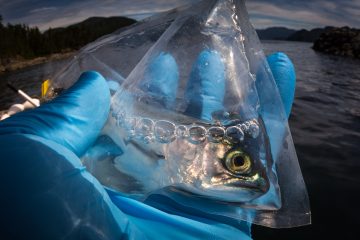
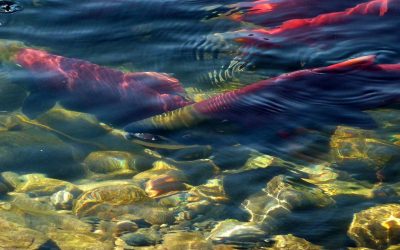
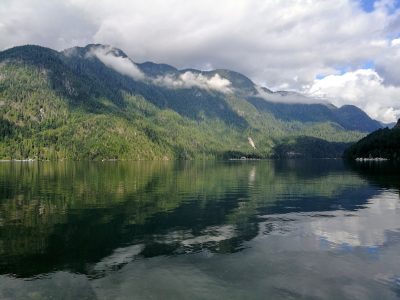
The Pacific Legacy, with her commercial fishing crew of eight and 12 scientists from Canada, Russia, and the United States, left Victoria harbour on the evening of March 11, 2020. As of March 20 they have completed 17 sets. There were no salmon in the two sets within the Canadian EEZ. In the next 15 sets we have approximately 440 salmon which exceeds the total salmon catch of 417 in our 2019 expedition. We are catching all species except for Chinook salmon but including one steelhead. It was a rough start with high winds, but the science crew recovered quickly and are in good spirits once they got their sea legs.
Until more of the survey area has been sampled, it is early to interpret results or variation in catch patterns. However, a first impression is that the catch pattern and abundances are different from last year. It is possible that the low catches last year were an index of the exceptionally poor coast wide returns of most species. If the stock specific catches this year relate to the returns this fall, it may show that these surveys can provide an early warning of return abundances. Our catches so far also contain excellent samples of chum, pink, coho and sockeye that will allow participants to test their hypotheses about the mechanisms regulating salmon production.
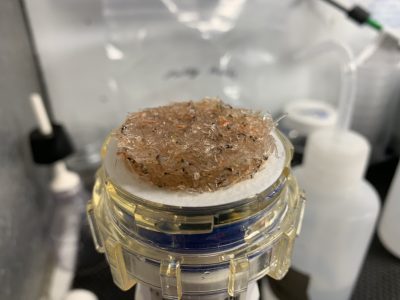
In addition to fishing, a CTD and plankton set has been conducted at each station and water samples for environmental DNA have been collected. The vessel and crew are scheduled to continue fishing the SW portion of the survey grid over the next few days. Following this they will be headed to Prince Rupert for fuel on March 24. Due to current conditions with the coronavirus, there will be no crew changes in Prince Rupert and the science team on board will continue for the duration of the expedition. Everyone is appreciative of the exceptional abilities of the crew of eight and the support of Brian Mose who is an owner of the vessel and can get anything done.
This is the second collection of articles by Daniel Pauly and colleagues that were deemed not suitable for peer-reviewed scientific journals, but which readers may find of interest. There is very little that Daniel Pauly writes that is not of interest to fisheries researchers, whether peer-reviewed or not. Such are the trials of a man whose lifetime of work has been so foundational in the fields of fisheries science and biodiversity research. We should all aspire to such tribulations.
Here, Dr. Pauly pays homage two of his mentors, as well as with his colleagues sharing articles that range from marine biodiversity in the Indo-Pacific to fisheries management in the Small-Island States, from marine mammals in the Sea of Okhotsk to the Gill-Oxygen Limitation Theory (GOLT). The topics are widespread, but all are interesting.
The discoloured fish that rest in glass jars in museums across the world are normally used by specialists as references to study the traits that identify certain species. But a new study proposes an additional use for such ‘samples.’
Published in the Journal of Applied Ichthyology, the paper proposes using such specimens to estimate the length-weight relationships of fish that are hard to find alive in their natural environment.
“The length-weight relationship of fish, which allow computing the weight from their length, is something marine biologists need for a wide variety of studies. For example, they need them when they are estimating the biomass of certain species by performing visual census either by scuba diving or by using remote observation vehicles or underwater video stations,” said Amanda Hay, lead author of the study and a researcher at the Australian Museum Research Institute.
But some fish like those that live in deep waters are so difficult to reach and observe that a museum specimen may be the only known representative of the species. “This is why it is so important to ‘extract’ as much information as possible from that individual,” Hay said.
Walking catfish –Clarias batrachus, part of the Beaty Biodiversity Museum Collection. Image courtesy of the Beaty Biodiversity Museum.
When live fish are hard to catch for the researchers who study them, the most common practice is to assume that their biological traits equate to those of similar species. Using preserved fish specimens, however, is a more precise way to learn more about elusive species.
The proof of concept prepared by Hay and her colleagues at Canada’s Beaty Biodiversity Museum and China’s Institute of Oceanology involved measuring 56 preserved adult specimens of 31 species and uploading their results to FishBase, the largest online database on fish.
“FishBase has information for over 30,000 fish species but, of those, only 5,500 have length-weight parameters,” said Daniel Pauly, co-author of the study and principal investigator of the Sea Around Us initiative at the University of British Columbia’s Institute for the Oceans and Fisheries. “This can be improved if researchers in museums and other institutions around the world measure and weigh specimens in their collections and upload the data. This is what we are aiming for.”
The paper “The why and how of determining the length-weight relationships of fish from preserved museum specimens” was published today in the Journal of Applied Ichthyology, https://doi.org/10.1111/jai.14014.


 Worldwide, the impacts have also been mostly negative for small-scale fisheries. At the beginning of the COVID-19 pandemic many fisheries faced complete shutdowns as they were not considered vital to national food supply systems. Ports, markets and processing facilities were also closed due to the close quarters and risks of spreading COVID-19. Export-oriented small-scale fishers faced a vast reduction in demand and slashed prices. Even in fisheries that remained open, people had to make difficult decisions about feeding their families or risking exposure. Some groups, such as migrant workers and women – who comprise 80 to 90 per cent of the post-harvest sector – are bearing the brunt of the pandemic.


 The Pacific Legacy, with her commercial fishing crew of eight and 12 scientists from Canada, Russia, and the United States, left Victoria harbour on the evening of March 11, 2020. As of March 20 they have completed 17 sets. There were no salmon in the two sets within the Canadian EEZ. In the next 15 sets we have approximately 440 salmon which exceeds the total salmon catch of 417 in our 2019 expedition. We are catching all species except for Chinook salmon but including one steelhead. It was a rough start with high winds, but the science crew recovered quickly and are in good spirits once they got their sea legs.
 This is the second collection of articles by Daniel Pauly and colleagues that were deemed not suitable for peer-reviewed scientific journals, but which readers may find of interest. There is very little that Daniel Pauly writes that is not of interest to fisheries researchers, whether peer-reviewed or not. Such are the trials of a man whose lifetime of work has been so foundational in the fields of fisheries science and biodiversity research. We should all aspire to such tribulations.

