Photo credit: Thomas Seitz, LGL Limited (William Koski), Fisheries and Oceans Canada (Steve Ferguson), WWF-Canada (Brandon Laforest), University of British Columbia (Sarah Fortune), Pangnirtung HTO and Ricky and Peter Kilabuk.
Bowhead drone photo 2
Photo credit: Thomas Seitz, LGL Limited (William Koski), Fisheries and Oceans Canada (Steve Ferguson), WWF-Canada (Brandon Laforest), University of British Columbia (Sarah Fortune), Pangnirtung HTO and Ricky and Peter Kilabuk.
Bowhead drone photo 1
Photo credit: Thomas Seitz, LGL Limited (William Koski), Fisheries and Oceans Canada (Steve Ferguson), WWF-Canada (Brandon Laforest), University of British Columbia (Sarah Fortune), Pangnirtung HTO and Ricky and Peter Kilabuk.
Research into bowhead whales finds unique foraging behaviour
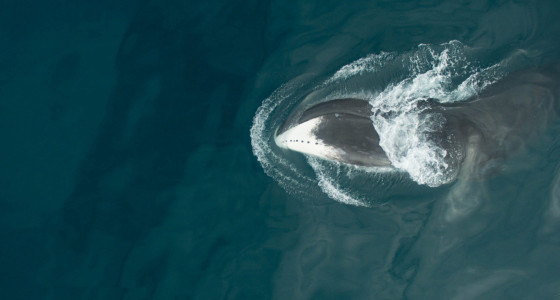
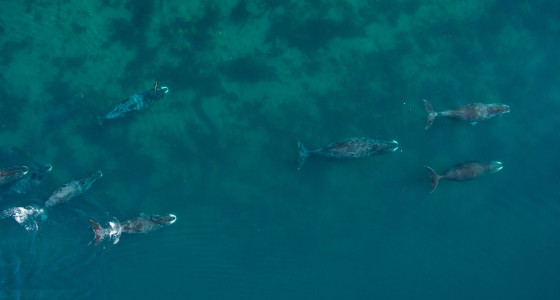
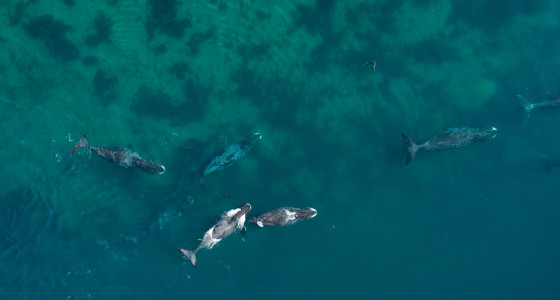
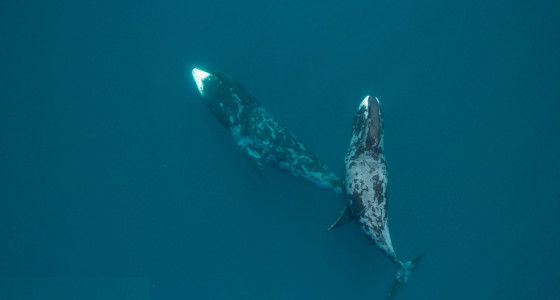
Over the course of a four-year-long study in Cumberland Sound, Nunavut, researchers from the Institute for the Oceans and Fisheries (IOF) at the University of British Columbia, Woods Hole Oceanographic Institution, and Fisheries and Oceans Canada discovered that bowhead whales have more flexible feeding behaviours than previously expected.
The researchers tracked the whales using tags that recorded the time the whales spent underwater and the depths to which they dove. They compared this information with another dataset they collected which covered the distribution, abundance and composition of bowhead prey species at different water depths. Their goal was to get a clearer picture of bowhead feeding behaviour.
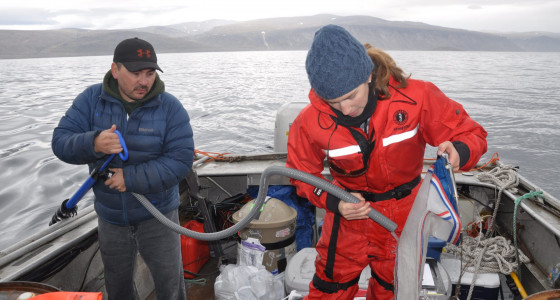
As they collected this data in a remote corner of Nunavut with unpredictable weather, the team was tested with a series of challenges. “As prepared as you are and as keen as you are to get out, if you have bad ice conditions then it’s impossible,” said Sarah Fortune, the study’s lead investigator and guest researcher at the IOF. “We ran a two-vessel operation. Normally with this type of project you’d have a large oceanographic vessel with all of your equipment onboard and you’d live on the boat… but we were working with smaller boats. Every day we were in the field we’d have to haul our equipment off the boat, which was a huge oceanographic cage with all these instruments mounted in it.”
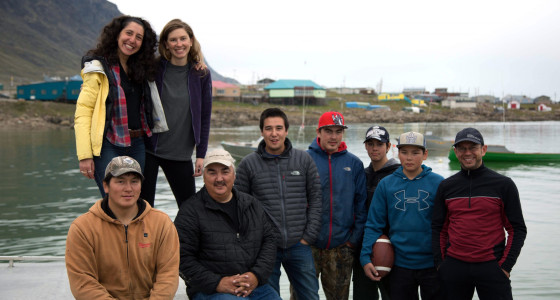
Fortune attributes the project’s success to a close collaboration with the local Inuit people of the region.
“They had quite a bit of experience working on the water with bowheads and knowing the places to look, the times to look, and they were able to read the whales really well,” she said.
What surprised the researchers most was that the bowheads had a distinctive feeding pattern, moving between different “prey layers” (the water depths where different prey species reside), instead of consistently feeding in the same locations. The whales tended to seek out more energy-rich zooplankton located at greater depths. However, they alternated between deep dives and shallow dives, occasionally forgoing the larger zooplankton deeper underwater to feed on the less energy-dense species closer to the water’s surface.
Bowhead whale photo 4
Photo credit: Thomas Seitz, LGL Limited (William Koski), Fisheries and Oceans Canada (Steve Ferguson), WWF-Canada (Brandon Laforest), University of British Columbia (Sarah Fortune), Pangnirtung HTO and Ricky and Peter Kilabuk.
Bowhead whale photo 3
Photo credit: Thomas Seitz, LGL Limited (William Koski), Fisheries and Oceans Canada (Steve Ferguson), WWF-Canada (Brandon Laforest), University of British Columbia (Sarah Fortune), Pangnirtung HTO and Ricky and Peter Kilabuk.
Bowhead drone photo 2
Photo credit: Thomas Seitz, LGL Limited (William Koski), Fisheries and Oceans Canada (Steve Ferguson), WWF-Canada (Brandon Laforest), University of British Columbia (Sarah Fortune), Pangnirtung HTO and Ricky and Peter Kilabuk.
Bowhead drone photo 1
Photo credit: Thomas Seitz, LGL Limited (William Koski), Fisheries and Oceans Canada (Steve Ferguson), WWF-Canada (Brandon Laforest), University of British Columbia (Sarah Fortune), Pangnirtung HTO and Ricky and Peter Kilabuk.
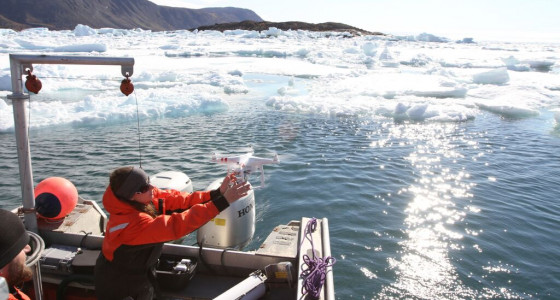
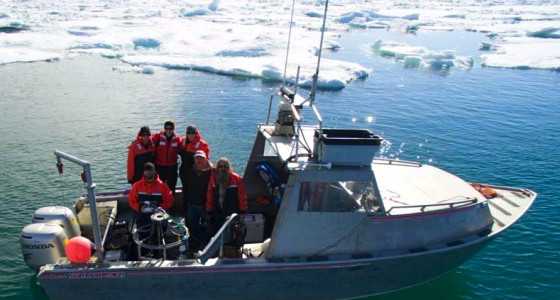
“It may be that the whales are doing a cost-benefit analysis between the energy you would expend to dive deeper for longer vs. feeding on those lower-hanging fruit that are much more accessible,” Fortune said.
The researchers were also able to compare whale activity in two Cumberland Sound fiords that are nearby each other. Bowheads spent most of their time Kingnait Fiord, but rarely travelled to the adjacent Pangnirtung Fiord. The researchers speculated that the preference comes down to Kingnait having an energy rich and deep layer of large-bodied Arctic zooplankton.
“This study contributes two things,” said Andrew Trites, an IOF professor who contributed to the project as Fortune’s PhD co-supervisor. “One, it provides some important baseline information that can be used to interpret future changes that may occur in whale distributions, numbers and behaviours. The second is it also helps us to understand what bowhead whales need to survive.”
Understanding the needs of bowheads is a crucial first step taken to learn how they will respond to climate change.
Fortune says that the study also provides further evidence of the vast differences between human and animal awareness. “I feel as though with all of these foraging ecology studies what we routinely see is that these animals are far superior than we could ever be at detecting prey and at detecting large biomasses of prey,” Fortune said.
Tags:
Modelling provides insight into the risks microplastics pose to marine life
by Riley Tjosvold
New modelling from the Institute for the Oceans and Fisheries (IOF) indicates that microplastics (pieces of plastic less than five millimeters) accumulate in marine biota, but do not appear to magnify as they travel through marine food webs from zooplankton into fish, and ultimately marine mammals.
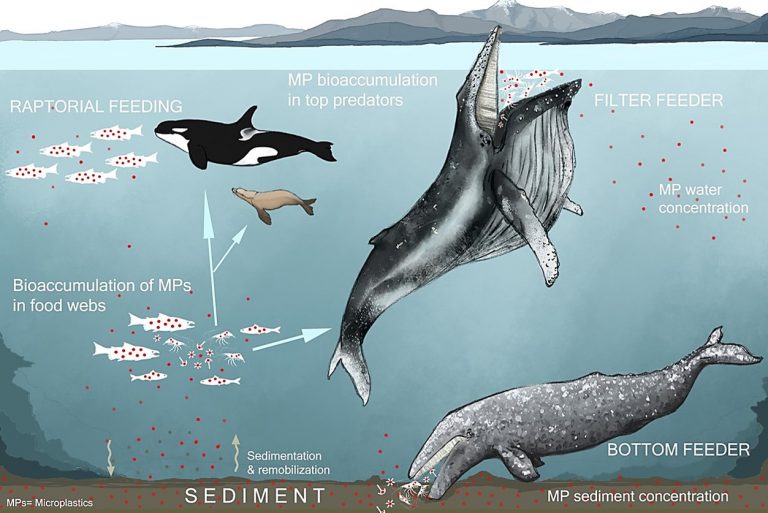
An illustration showing pathways for bioaccumulation of microplastics (MPs) in marine mammalian food webs, indicating the feeding preferences and foraging strategies in marine mammals (e.g., fish-eating killer whales, pinnipeds, filter-feeding humpback and bottom-feeding grey whales) and potential microplastic exposure via prey (zooplankton/krill, benthic crustaceans and fish). Artwork: Nastenka Alava Calle.
“They are a kind of new class of emerging contaminants that are bringing a lot of attention about the potential risks for marine fauna and coastal communities,” said Juan Jose Alava, principal investigator of the Ocean Pollution Research Unit (OPRU), and a research associate at the IOF who authored the study. “They are persistent because they take a long time to break down, and the material can cause some damage and health effects in marine organisms.”
That damage includes things like blocking the digestive tracts of fish and leaching toxic chemicals contained within the plastics into the tissues of marine life.
Alava built a computer model to test whether microplastics biomagnify (appear in larger and larger quantities or concentrations as they move up at each trophic level in the food web) and bioaccumulate (build up within the GI tract or other organs of marine life at a faster rate than they can be expelled). The model used sample data of water with low, medium and high concentrations of microplastics combined with data about the food webs, digestive processes and dietary habits of humpback and killer whales in the northeastern Pacific Ocean.
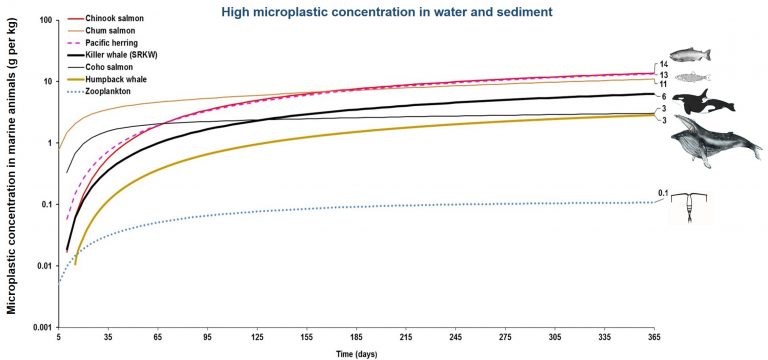
Figure showing the projections under a scenario of high microplastic concentration to predict the potential bioaccumulation in marine species of the food web. From the bottom to the top: zooplankton, humpback whale, southern resident killer whale, Pacific herring and Chinook salmon.
The models revealed that microplastics biomagnified scarcely in the two whale species examined. However, Alava cautioned that to get a more accurate picture of the dangers of microplastic biomagnification, the model needs to be applied to more food webs. Moreover, the models indicated that microplastics do bioaccumulate, especially in smaller species of zooplankton and fish, and thus pose a threat to marine life.
“The takeaway is that we learned that the water and sediments are polluted with microplastics. The global ocean is basically a dump,” Alava said. “We need to change our behaviours, our preferences and our consumption. The world’s population is depending on plastics. Yet, they’re everywhere. The idea is to change to a more clean, plastic-free and biodegradable source of products.”
Alava’s model is freely available and he hopes that other researchers will make use of it to see whether microplastic biomagnification presents risks to species not yet examined.
A visual snapshot on Microplastic bioaccumulation/biomagnification can be found at the following microplastic bioaccumulation video Microplastic Bioaccumulation Infographic from Nastenkita Alava on Vimeo.
Tags: IOF Research Associates, Juan Jose Alava, OPRU, plastic, pollution
Nisga’a scholar launches new Centre for Indigenous Fisheries at UBC
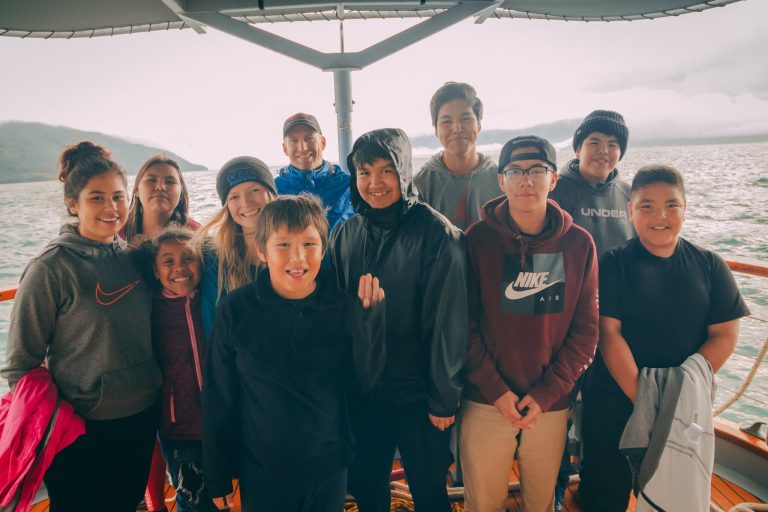
Andrea Reid and John-Francis Lane with their salmon science camp participants from the Nisga’a village of Gingolx in the Portland Inlet on B.C. north coast in 2018. Credit: Andrew Stewart
A new Centre for Indigenous Fisheries (CIF) is being launched at University of British Columbia, with Indigenous fisheries scientist, conservation biologist and Nisga’a Nation member Dr. Andrea Reid joining as Principal Investigator.
The CIF, which will be based at the Institute for the Oceans and Fisheries, aims to support the management of aquatic ecosystems and fisheries in Canada and beyond by combining Indigenous knowledge systems and modern science. Professor Emerita and fisheries historian Dr. Dianne Newell will serve as the Interim Director, and a second faculty appointment is anticipated for the near future.
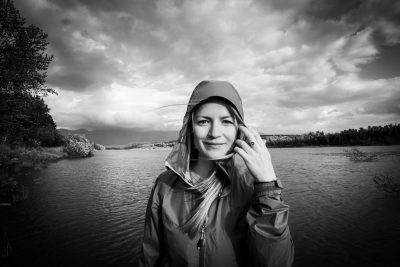
Andrea Reid on the Skeena River, just outside of Terrace, B.C. in 2018. Credit: Talon Gillis
What do you hope to achieve with the new Centre for Indigenous Fisheries?
We are working towards a future where culturally significant fish and fisheries are valued and protected in the long-term. Our research is fundamentally community-centred, employing both Indigenous research methodologies as well as tools and understandings from both Indigenous and Western sciences. This research will be done with communities, not on them – with their permission, oversight, and in response to community needs. Indigenous knowledges, methods and values will fundamentally steer what we do, how we do it, and where we go.
Teaching and training will also be a huge component of this work. We have already recruited new graduate students to our team, the majority of whom are Indigenous. We are also working to bring forward new courses at UBC aimed at providing guidance to those who are working with Indigenous community partners or seeking to do so, or who wish to become knowledgeable of Indigenous issues, histories, and knowledge systems in this country.
Can you share examples of some projects CIF will be undertaking?
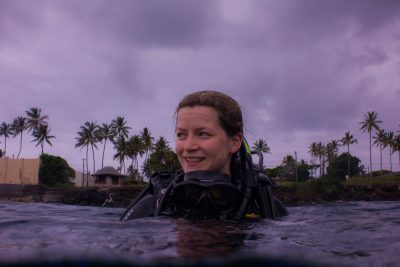
Andrea Reid surfacing after a dive on Moloka’i, Hawai’i, where she and colleagues were using photogrammetry to document changes in coral reef structures in 2014. Credit: Mikayla Wujec
This project is made possible by a grant from the National Geographic Society, and will be co-led by myself and three fellow National Geographic Explorers: Lauren Eckert, a conservation scientist; Amy Romer, a documentary photographer and storyteller; and Rena Priest, a poet and writer from the Lhaq’temish (Lummi) Nation.
Through a combination of archival research, workshops and interviews with fishers and knowledge keepers, it is our ambition to share the under told story of how Indigenous fisheries and stewardship practices have been usurped, dishonoured, thwarted, appropriated and criminalized through colonization. Canoes, boats, nets and other fishing gears have repeatedly been confiscated; fishers have been excluded from fishing certain waters; in many cases they have faced large fines or incarceration; and threats of violence have been acted upon by authorities when fishers have stood up for their inherent rights. In not acknowledging and reckoning with this history and reality, there can be no lesson taken from it, locally or beyond.
We will also work with interested community partners to explore what more just and sustainable futures look like in their view for Indigenous fishing communities in the Salish Sea, and we hope to shine a big spotlight on these issues and solutions through multi-media storytelling.
Why is research like this important?
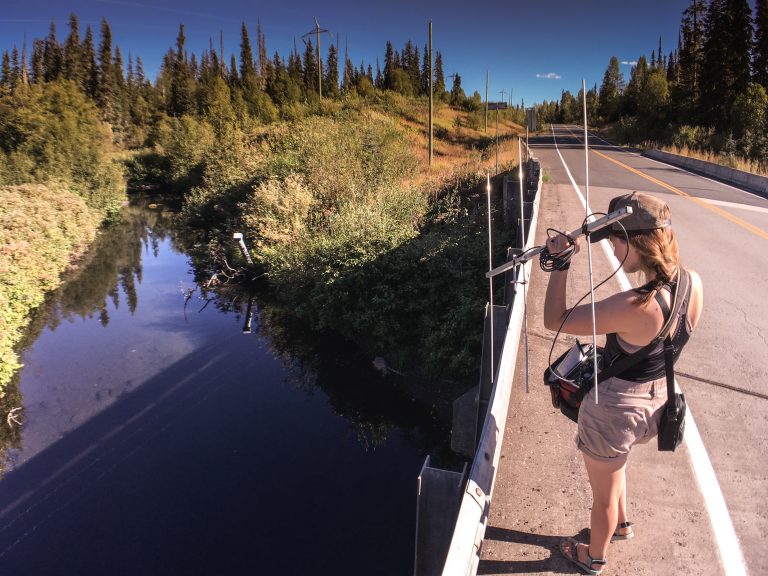
Andrea Reid using a radio telemetry receiver to listen for radio-tagged sockeye salmon in the Nass River watershed in northern B.C. in 2016. Credit: Colin Middleton
If we don’t understand the histories and rich contexts of these human dimensions, and if we don’t include associated communities equitably in the research process, then we’re missing a big part of the puzzle and risk continuing research practices that are potentially extractive and quite harmful. The United Nations Declaration on the Rights of Indigenous Peoples (UNDRIP) and other policy instruments like the Truth and Reconciliation Commission Calls to Action ask something much different from us as researchers.
In another project CIF is launching this year, we are partnering with several First Nations in the Lower Fraser to co-develop biocultural indicators of aquatic ecosystem and fish health. This is being modelled after the Māori Cultural Health Index which was developed to help Māori meaningfully participate in the management of fresh waters in Aotearoa, or New Zealand, so that how the health of these systems is measured also reflects Māori values and knowledge. We hope to bring this framework here, so we can have a toolkit option for B.C. First Nations that creates a pathway for bringing Indigenous perspectives and knowledge of aquatic health into management decisions and actions.