Pyrosomes appearing in BC waters
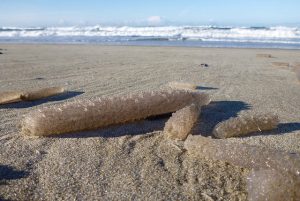
Pyrosomes, minustide/Flickr, CC2.0
The summer of 2017 has seen the development of unprecedented swarms of pyrosomes in the north-east Pacific. What is most unusual is that pyrosomes are typically found in tropical and sub-tropical oceans.
Pyrosomes are free drifting tunicates, microscopic gelatinous zooplankton that form colonies from a few centimetres in size to well over a metre. Pyrosomes are not toxic, or predators, but are grazers of microscopic algae, phytoplankton. Their colonies are long, tubular, and quite firm to the touch, which is why some refer to them as “sea pickles.” Pyrosome translates to “fire body,” in reference to their powerful bioluminescence, which can be seen at night when they are disturbed.
Since the Spring, massive numbers have been observed from Oregon to SE Alaska. In British Columbia, Moira Galbraith, a zooplankton biologist with the Department of Fisheries and Oceans, reports that they have been observed from the west coast of Vancouver Island to hundreds of miles offshore. In Oregon, Dr. Rick Brodeur of the Northwest Fisheries Science Center reported a haul of 60,000 pyrosomes from a 5-minute net trawl.
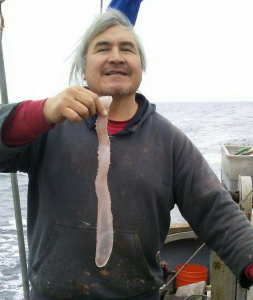
Pyrosome, Photo ©: Dobie Lyons
Although it is not clear what has caused the introduction of these animals into BC waters, it is possible that the marine heat wave experienced in the 2014 and 2015, and subs-sequent El Nino in the 2016 winter, may have been contributing factors. Not only did these events warm the ocean, but they also transported warm, southern waters of the California Current into British Columbia.
What impact might these animals have on our BC ecosystems? As grazers, pyrosomes are expected to compete with crustacean zooplankton, including copepods and krill, for their phytoplankton food. This is potentially disruptive to the typical BC food webs, directing resources away from the copepods and krill that sustain fish species such as herring and salmon. Because of their gelatinous bodies, pyrosomes have low nutritional value, and although there are reports from the Central Coast of halibut consuming large quantities of these organisms, it is unlikely that they are able to support themselves on a pyrosome diet.
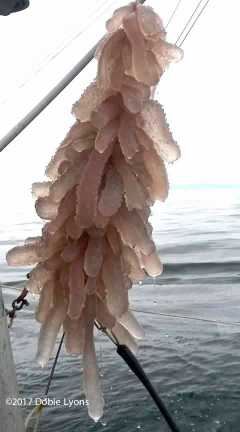
Pyrosomes on trawler gear, Photo ©: Dobie Lyons
Pyrosomes may also present challenges to local fisherman by clogging the gears used to catch their fish.
The Department of Fisheries and Oceans and the Hakai Institute’s ongoing ocean observing programs will be keeping a close eye on how this pyrsosome bloom persists and its implications for the BC Pacific marine ecosystem.
Dr. Brian Hunt
by Dr. Brian Hunt
Assistant Professor, Institute for the Oceans and Fisheries
UBC Hakai Professor in Oceanography
Related stories
- Jellied sea creatures confound scientists, fishermen on U.S. Pacific Coast, Reuters, June 27, 2017
- Millions of tropical sea creatures invade waters off B.C. coast, CBC News, June 18, 2017
- Bizarre, Glowing Sea Creatures Bloom in the Pacific, National Geographic, June 13, 2017
Tags: Brian Hunt, British Columbia, faculty, plankton, pyrosomes
Early Career Awards (CSEE)
The Canadian Society for Ecology and Evolution (CSEE) Early Career Awards recognize outstanding accomplishments and promising future research potential in ecology and evolution by scientists early in their career. Awards will be given to two candidates each year.
Awards consist of a 10-year membership to CSEE/SCEE, $500 cash award, up to $1000 allowance for travel and accommodation to attend the CSEE meeting, and an invitation to give a keynote lecture at the annual meeting.
Nomination package
- a curriculum vitae,
- a summary of research accomplishments (maximum 2 pages),
- a 2-page statement of research plans for the next 5 years,
- three recent publications,
- names and addresses of 3 referees (including the nominating scientist where applicable) who will provide supporting letters. The 3 letters of reference should be sent separately from the candidate’s nomination package.
Deadline: January 26, 2018
Ten million tonnes of fish wasted every year despite declining fish stocks
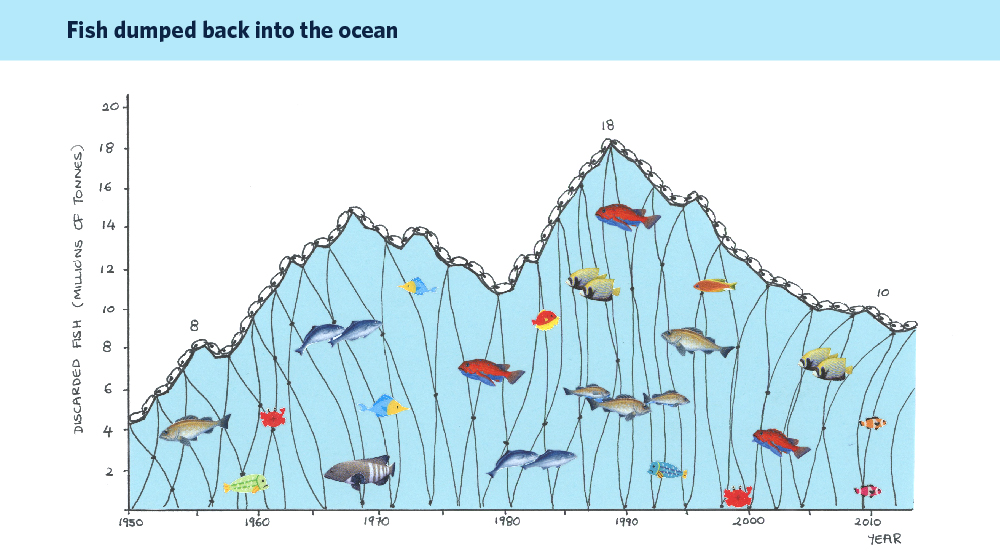
Industrial fishing fleets dump more than 9.7 million tonnes of good fish back into the ocean every year, according to new research.
The study by researchers with the Sea Around Us, an initiative at the University of British Columbia’s Institute for the Oceans and Fisheries and the University of Western Australia, reveals that almost 10 per cent of the world’s total catch in the last decade was discarded due to poor fishing practices and inadequate management. This is equivalent to throwing back enough fish to fill about 4,500 Olympic sized swimming pools every year.

Dirk Zeller
“In the current era of increasing food insecurity and human nutritional health concerns, these findings are important,” said Dirk Zeller, lead author for the study who is now a professor at the University of Western Australia and senior research partner with the Sea Around Us. “The discarded fish could have been put to better use.”
Fishers discard a portion of their catch because fishing practices damage the fish and make them unmarketable, the fish are too small, the species is out of season, only part of the fish needs to be harvested—as with the Alaska pollock roe—or the fishers caught species that they were not targeting, something known as bycatch.
“Discards also happen because of a nasty practice known as high-grading where fishers continue fishing even after they’ve caught fish that they can sell,” said Zeller. “If they catch bigger fish, they throw away the smaller ones; they usually can’t keep both loads because they run out of freezer space or go over their quota.”
The study examined the amount of discarded fish over time. In the 1950s, about five million tonnes of fish were discarded every year, in the 1980s that figure grew to 18 million tonnes. It decreased to the current levels of nearly 10 million tonnes per year over the past decade.
The decline in discards in recent years could be attributed to improved fisheries management and new technology, but Zeller and his colleagues say it’s likely also an indicator of depleted fish stocks. As the Sea Around Us‘ 2016 global catch reconstruction paper revealed, catches have been declining at a rate of 1.2 million tonnes of fish every year since the mid-1990s.
“Discards are now declining because we have already fished these species down so much that fishing operations are catching less and less each year, and therefore there’s less for them to throw away,” he said.
Zeller and his colleagues Tim Cashion, Maria Palomares and Daniel Pauly, say that the study also shows how industrial fleets move to new waters once certain fisheries decline.
“The shift of discards from Atlantic to Pacific waters shows a dangerous trend in fisheries of exporting our fishing needs and fishing problems to new areas,” Cashion said.
The paper “Global marine fisheries discards: a synthesis of reconstructed data” was published today in Fish & Fisheries.
Tags: Daniel Pauly, Deng Palomares, Dirk Zeller, faculty, IOF Research Associates, Sea Around Us
Illegal foreign fishing and lack of reporting threaten Sierra Leone’s fisheries sector
Illegal fishing accounts for about 30 per cent of catches by industrial foreign fleets in Sierra Leone, says a new study published in Marine Policy.
The paper states that, in the past decade, industrial foreign vessels have increased their presence and illegal activities in Sierra Leonean waters either on their own or by enticing small- scale fishers into illicit partnerships, such as acting as transshipment vessels in nearshore areas.
Reduced monitoring, control, and surveillance, related to the withdrawal of development aid, is spurring unlicensed operations, researchers say. The study estimates that more than 42,000 tonnes of fish were caught illegally in 2015 alone.
On top of this, most of the West African country’s industrial fishing is carried out – both legally and illegally – by foreigners using destructive bottom trawl gear. In some years, foreign catches approached or surpassed the limit of how much could sustainably be fished from Sierra Leone’s Exclusive Economic Zone. “This has profound impacts on the lives of local fishing communities,” says Katy Seto, PhD candidate at the University of California at Berkeley, and the lead author of the study.
Using the Sea Around Us‘ catch reconstruction method, which complements the Food and Agriculture Organization’s fisheries data by incorporating unreported catches, the researchers were able to provide comprehensive estimates of how much fish was really caught by the industrial and small-scale sectors and under what circumstances from 1950 to 2015.
Their results show that total catches were over 2 times higher than what FAO reported.
Substantial challenges to fisheries governance, lack of infrastructure, and weak enforcement capacity to exclude illegal actors explain the numerical gap. “While Sierra Leone’s authorities are actively fighting illegal fishing, structural and financial limitations represent major threats to the country’s fisheries sustainability,” Seto says. These threats further compound existing challenges to food security, livelihoods, and economic growth in a country ranked as one of the poorest in the world and still recovering from a deadly civil war and a recent Ebola epidemic.
Local officials are also striving to know more about the state of their fisheries, and are considering incorporating the catch reconstruction method into their statistical system, says the Sea Around Us’ advisor for West Africa, Dyhia Belhabib, a co-author of the study. This is important because “by knowing what and how much each sector is catching, particularly those that are underreported, they will be able to prioritize better,” Belhabib adds.
The paper “War, fish, and foreign fleets: The marine fisheries catches of Sierra Leone 1950– 2015” is a joint research by scientists from the University of California at Berkeley; the Sea Around Us project, based at the University of British Columbia’s Institute for the Ocean and Fisheries and the University of Western Australia; and five other organizations and institutions.

Tags: IOF alumni, Sea Around Us
Croonian Medal and Lecture (Royal Society of London)
This prize lecture is the premier lecture in the biological sciences and is delivered annually at the Royal Society in London. This award is open to all international applicants, at a senior level. Teams or groups may be nominated for this award. Nominations are valid for 3 years.
Nomination requirements:
- Nominators are invited to provide information on why the nominee should be
considered for the medal, a brief summary of the nominee’s career history and a
statement of support - Nominators are also required to list the nominee’s most significant achievements and
contributions to science (maximum of 20 examples). - Achievements and contributions may include commercialisation, entrepreneurial or
industrial impacts, patents, open data sets, influence on policy outcomes, public
engagement, collaborations or individuals instructed, methodological improvements,
publications, etc
Prize
Gift of £10,000 and associated lecture
Deadline: Usually mid-February
Copley Medal (Royal Society of London)
The Copley Medal is the Royal Society of London’s oldest and most prestigious award. The medal is now awarded annually for outstanding achievements in research in any branch of science. The award alternates between the physical and biological sciences (odd and even years respectively).
This award is open to all international applicants, at a senior level. Teams or groups may be nominated for this award. Nominations are valid for 3 years.
Nomination requirements:
- Nominators are invited to provide information on why the nominee should be
considered for the medal, a brief summary of the nominee’s career history and a
statement of support - Nominators are also required to list the nominee’s most significant achievements and
contributions to science (maximum of 20 examples). - Achievements and contributions may include commercialisation, entrepreneurial or
industrial impacts, patents, open data sets, influence on policy outcomes, public
engagement, collaborations or individuals instructed, methodological improvements,
publications, etc
Prize
A medal of silver gilt and a gift of £25,000 at the Premier Awards dinner in Autumn
Deadline: Usually end of January This year: 21 February 2026
Marine Mammal Skeleton Exhibit
The Marine Mammal Skeleton Exhibit helps promote public understanding of marine mammals and the ecosystems in which they live. It included the skeletons of a minke whale, killer whales, three Pacific white-sided dolphins and two Steller sea lions.
These specimens are native to British Columbia and were recovered and cleaned by students and volunteers. Articulation was done by Michael deRoos.
The Marine Mammal Skeleton Exhibit is a joint initiative between the Marine Mammal Research Unit (under Dr. Andrew Trites) and the employees of Petro-Canada Burrard Products Terminal.

Tags: Andrew Trites, Marine Mammal Research Unit, marine mammals