Scientists want to monitor the seals’ growth, body conditions, age and sex-composition, and breeding potential, to ensure that this vulnerable species continues to escape extinction.Photo: Andrew Trites
Another established resting site
Now another established resting or “haul-out” site has been found on El Fallarón de San Ignacio Island on the eastern side of the Gulf of California. Photo: Jorge Paul Orduño García
Only one breeding location
There is only breeding location for these seals on Guadalupe Island, in the Pacific Ocean, with another established haul-out nearby on the San Benito Islands. Photo: Jorge Paul Orduño García
“Eared” seals
Dark brown to grayish-black, Guadalupe fur seals are members of the ‘eared seal’ family (Otariidae), and have visible earflaps (pinnae). Photo credit: Luis M Burciaga
Artisan fishers near El Fallarón de San Ignacio Island
El Fallarón de San Ignacio Island on the eastern side of the Gulf of California, is also an important artisan fisheries site, and researchers want to monitor the area closely so that no conflict occurs. Photo credit: Photo: Jorge Paul Orduño García
Sexual dimorphism in Guadalupe fur seals
Sexual dimorphism – males being larger than females – in Guadalupe fur seals. Photo credit: Luis M Burciaga
Guadalupe fur seal
Hunted nearly to extinction for their fur, these seals have increased in number since the 1950s. Photo credit: Luis M Burciaga
Getting a step closer to understanding how Chinook salmon live
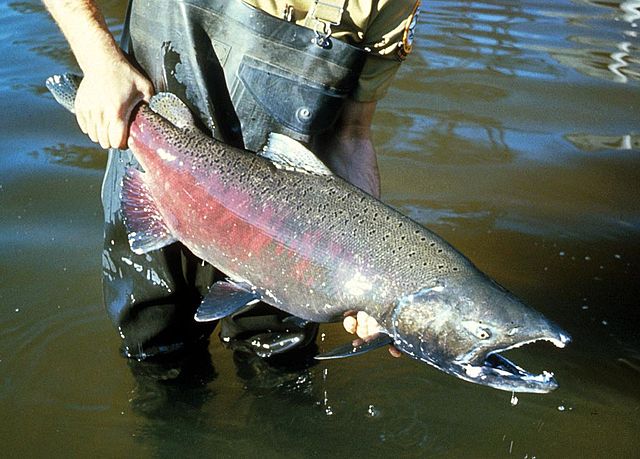 The life cycles and foraging behaviours of salmon in the ocean are shrouded in mystery because of the vast territory that they cover. Most of our knowledge of salmon life cycles comes from the coast, often only at the point of capture as they return to their native rivers to spawn. It is for this reason that the ocean life phase of salmon is often called a “black box.”
Stable isotope analysis, which measures the ratios of naturally occurring isotopes of elements such as carbon and nitrogen, can peel back the curtain to give scientists a view of where fish spend their time, what they’ve been eating, and how they are interacting with other species. The method works by matching the isotope ratios in the fish with the unique isotope “signatures” of the regions they inhabit and the organisms that they eat.
Questions remain about how much the ratio of these isotopes changes as they move through the food web, from phytoplankton, where they get absorbed during photosynthesis, to salmon — or how much the isotopes are “enriched.”
Researchers from the IOF experimented with Chinook salmon to see whether their understanding of how the stable isotopes accumulate in the fish was accurate.
“Assumptions about stable isotopes in Chinook salmon are based on experimental work on species in other regions,” said Jacob Lerner, a PhD student in the Pelagic Ecosystems Lab at the IOF and the study’s lead author. “We were essentially operating only on assumptions about what the values we’re seeing in the salmon actually represent. Even slight differences in enrichment factors can lead to major differences in the way you interpret the results of stable isotope analysis. We really want to be confident that they were correct.”
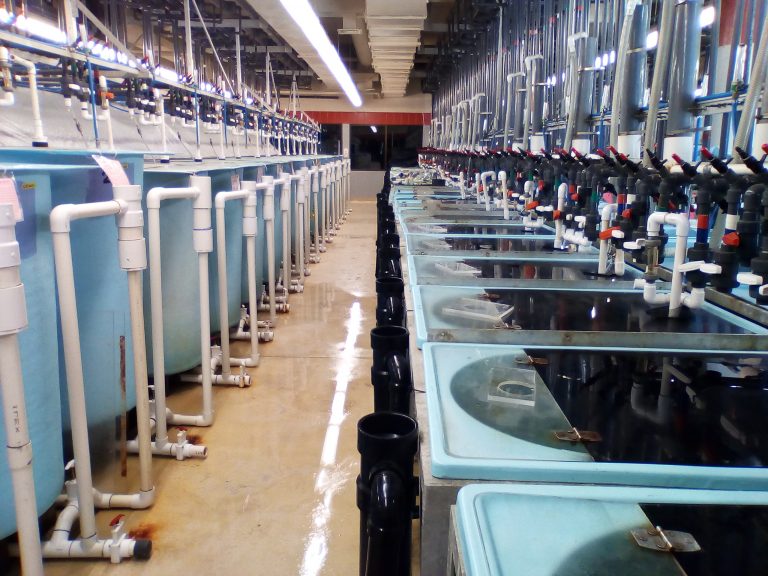
Testing the salmon at Pacific Science Enterprise Centre lab. Photo © Jacob Lerner
“The enrichment factor for nitrogen and carbon was very close to what we anticipated it would be, and that was awesome to see,” Lerner said. “It means that isotopes in Chinook salmon behave similarly to how they do in other organisms, and we can continue to apply a lot of the same rules that we expect.”
They tested both “bulk” stable isotopes, those found in muscle tissue, and used a more precise tool called compound-specific stable isotope analysis that measures isotopes in amino acids.
Although the ratio of isotopes in both tests was close to what the researchers predicted it would be, the isotopes identified through compound-specific stable isotope analysis varied more than expected.
The study is one of the first steps in a larger project that aims to understand chinook salmon life cycles and foraging behaviours.
“Going forward we can apply our calibrations to better understand the life history of Chinook salmon in the waters of the Northeast Pacific at large,” said Brian Hunt, an assistant professor at the IOF and co-author of the study. “We will be able to use this tool to separate more clearly where Chinook salmon are spending their time. That’s one of the things we think is important for our understanding of how ocean conditions affect the health of the returning fish — especially as oceans are altered by climate change.”
The authors thanked Yellow Island Aquaculture for providing Chinook salmon and the Department of Fisheries and Oceans for providing lab space in the Pacific Science Enterprise Centre.
The study “Experimentally derived trophic enrichment and discrimination factors for Chinook salmon, Oncorhynchus tshawytscha” was published in the journal Rapid Communications in Mass Spectrometry.
Tags: Brian Hunt, British Columbia, faculty, fish stocks, fisheries management, foraging, IOF students, life cycles, Research, salmon