
International Women in STEM Day at IOF: Science that Protects Oceans, Communities, and Futures
IOF is highlighting a few of the women across the Institute whose work shows what science looks like when it is built for impact.

Collectivizing Indigenous Knowledge: Reflections on the Taikura Tri-Academy Indigenous Summit
Centre for Indigenous Fisheries MSC student Kahsennarò:roks Deom attended the Taikura Tri-Academy Indigenous Summit in Aotearoa (New Zealand).
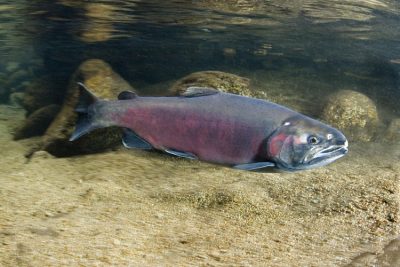
Fish farm pathogen risks not properly addressed in federal government’s framework: Study
It identifies key flaws that led DFO to conclude that T. maritimum is unlikely to cause disease in wild fish, and that PRV is not an infectious disease agent – despite credible scientific evidence to the contrary.
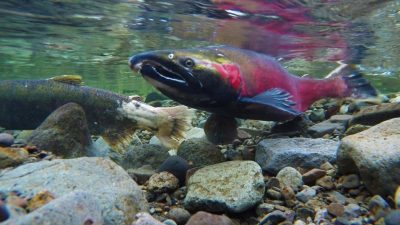
Bridging the gaps to save British Columbia’s salmon
Indigenous stewardship needs to be recognized and supported, giving First Nations and local communities clear decision making authority.
The future of Pacific salmon: Community dialogues underscore the urgent need for collaborative restoration
Thirteen public meetings to gather knowledge from local and Indigenous communities in support of salmon rebuilding and recovery in the Pacific Northwest.
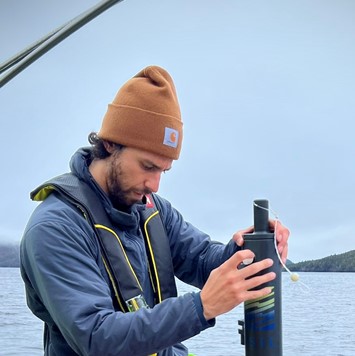
Student Profile: Alex (Alejandro) Schmill
Alejandro (Alex) Schmill is a first-year MSc student, co-supervised by Dr. William Cheung and Dr. Margot Hessing-Lewis of the Hakai Institute.
Indigenous data sovereignty and conservation in British Columbia
A collaborative study examined the concept of Indigenous data sovereignty in the context of salmon-bearing ecosystems in BC. The authors argue that successful conservation in the face of cumulative effects and climate change will require scientists to respect and incorporate Indigenous data sovereignty.
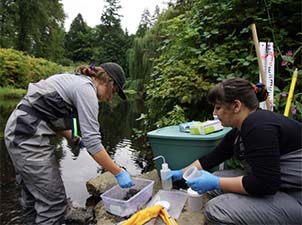
How to conduct scientific research with Indigenous Peoples and Lands in a good way
In a comment published in Nature Ecology & Evolution, authors outline four essential elements for conducting ecological research with and for Indigenous Peoples and Lands in a good way. In this Q&A, they discuss these elements and their importance for all scientific research.
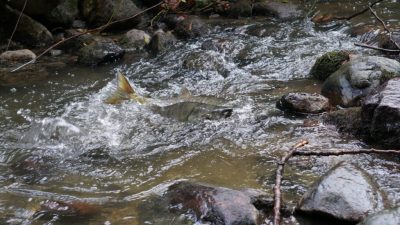
Salmon bones confirm sustainable chum fishery for 2,500 years under Tsleil-Waututh Nation
New research confirms that Tsleil-Waututh Nation has consistently and sustainably fished for chum salmon for 1,200 years longer than the archaeological record had previously demonstrated
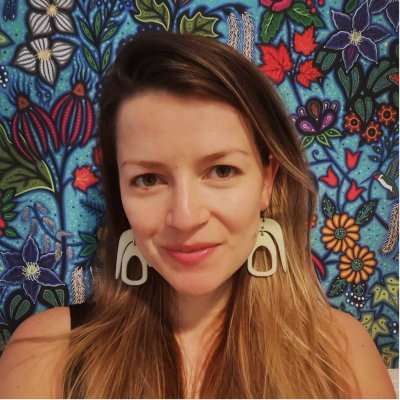
Dr. Andrea Reid appointed Tier 2 Canada Research Chair with additional awards for research on Indigenous fisheries conversation
Dr. Andrea Reid of the Nisg̱a’a Nation is one of UBC’s newest Tier 2 Canada Research Chairs (CRC). She also receives a grant through the Canadian Foundation for Innovation (CFI) John R. Evans Leaders Fund (JELF).