 |
Associate ProfessorInstitute for the Ocean and Fisheries IOF Graduate AdvisorResearch Unit |
Contact Information
Location: 243 AERL Building, 2202 Main Mall, Vancouver BC V6T 1Z9
Email: d.rosen@oceans.ubc.ca
Phone: (604) 822-8184
Website: Marine Mammal Research Unit
Social Media
Bluesky: @MMeanLab.bsky.social
Twitter: @MMeanLab
Biography
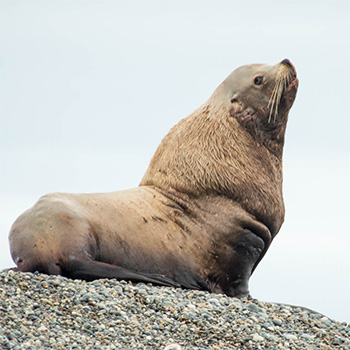
I did my undergrad in Marine Biology at the University of Guelph, which we touted as “equidistant from all three of Canada’s oceans”. It was there I was first exposed to marine mammal science, bioenergetics, and ecology. I decided to actually work near an ocean for my MSc, and settled on “The Rock” to study behavioural ecology under Dr. Deane Renouf at Memorial University. My thesis work was studying harbour seal mother/pup pairs on the nearby French Island of Miquelon. For my PhD, I chose to remain at MUN and work at the Seal Research Lab, but switch to a thesis more focused on physiology and energetics. The lab was deeply emeshed in the harp seal/cod controversy, and so I was convinced to switch coasts and work on the equally political Steller sea lion/pollock controversy. In 1998, I established the Marine Mammal Energetics and Nutrition Laboratory, which conducts both “pure” and conservation-directed research with groups of trained marine mammals (primarily Steller sea lions and northern fur seals) under human care at the Vancouver Aquarium and the Open Water Research Station in Port Moody.
Research Interests
My primary research has focussed on aspects of the bioenergetics (energy requirements and expenditures) of marine mammals. I use this approach to understand the root causes of population changes by investigating the interactions between the physiology of individual animals and biotic and abiotic environmental changes. The work directly contributes to the conservation and management of marine resources. I have also begun a research program investigating how marine mammals navigate long distances at sea. Many species undertake spectacular trips, arriving at an isolated location at a precise time – how do they manage this incredible feat? What natural signals do they use along the way? This research incorporates aspects of movement analysis, sensory physiology, and animal behaviour.
Degrees
PhD – Memorial University of Nfld
MSc – Memorial University of Nfld
Research Gate
Publications:
Related stories: